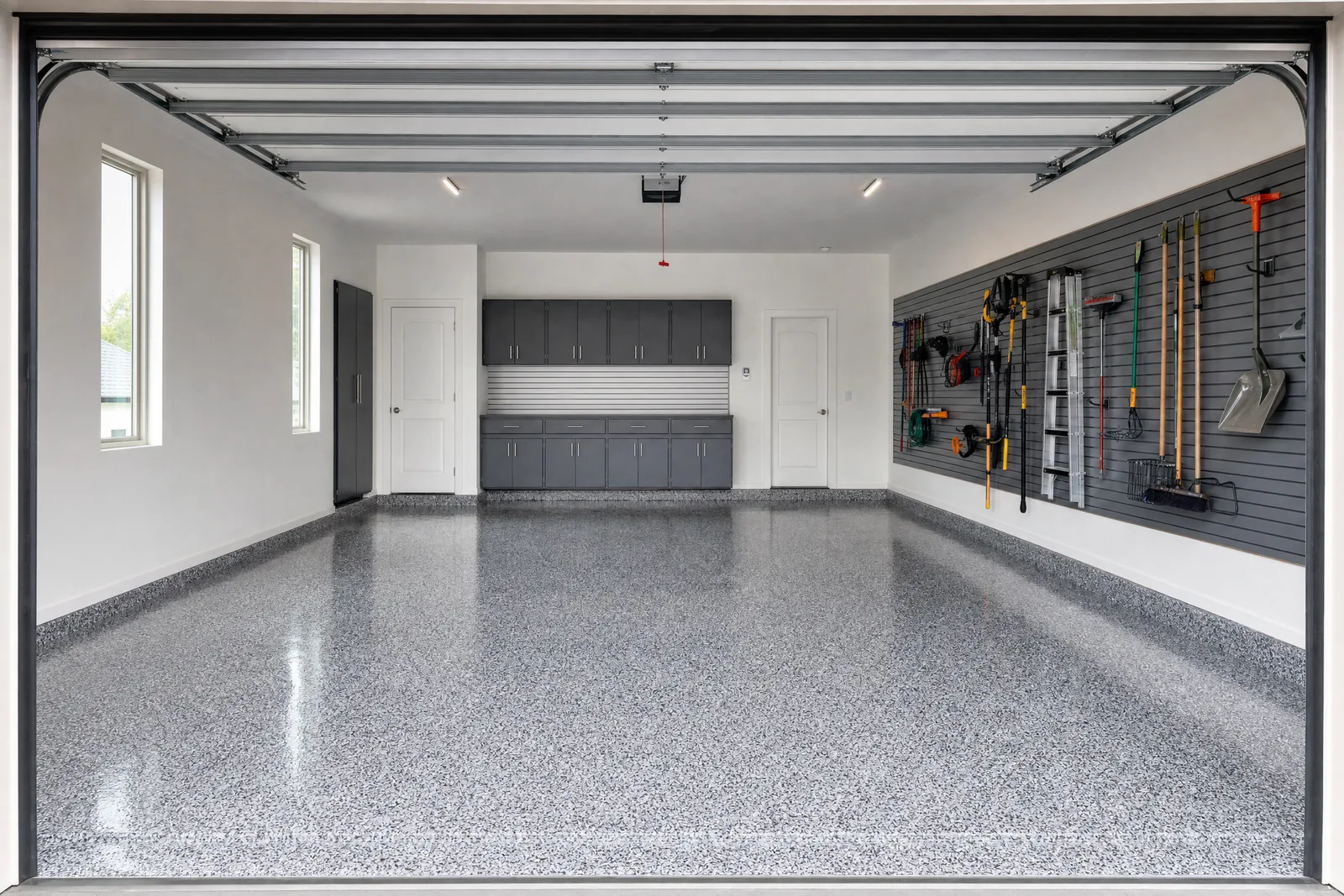
A garage floor coating is the only surface in your house that gets driven on, and in Reno it also gets a chemical bath every winter. NDOT runs magnesium chloride brine on I-80 and the Mt Rose Highway from November through March, and every trip up the hill brings it home packed in your wheel wells to drip onto the slab and sit. Add more freeze-thaw cycles than most genuinely cold cities see, and a bare garage floor here ages faster than almost anywhere.
We install full-broadcast flake, metallic, quartz and solid-color systems over a diamond-ground slab, finished with a polyaspartic topcoat that cures in an unheated garage, holds its colour under high-altitude sun, and shrugs off road brine. Most two-car garages are completed within a single working day, though larger floors and slabs needing significant repair can run longer.
What we install
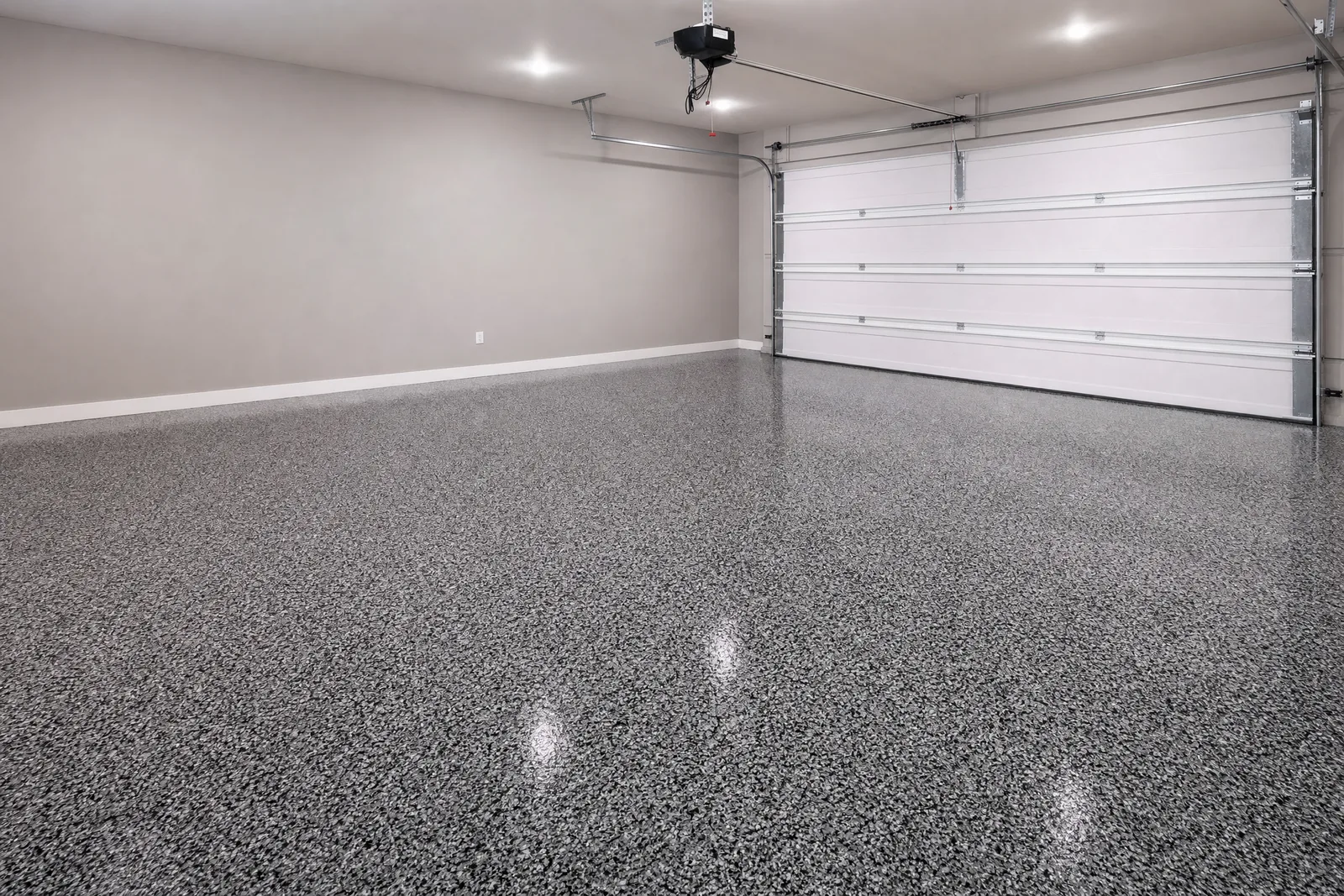
Flake systems
The workhorse. A full broadcast of vinyl chips hides slab imperfections, adds grip, and doesn't show dust or tire marks. Roughly four out of five residential floors we do.
Metallic epoxy
Pigment moves through the resin as it cures, so no two floors are alike. Dramatic under garage lighting. Needs a skilled installer and a sound slab.
Polyaspartic
Faster cure, far better UV stability than epoxy. This is what keeps the strip nearest your garage door from ambering to yellow after two Nevada summers.
Quartz broadcast
Graded quartz granules give a genuinely non-slip surface. Common on pool decks, patios and commercial kitchens where water is a factor.
Solid color
Clean and uniform. More common in shops and warehouses than homes, because a solid field shows every bit of dust and every repair underneath it.
Polished concrete
No coating at all — the slab itself is ground and densified to a sheen. Nothing to peel, but it can't hide a slab in poor condition.
Why floors fail here specifically
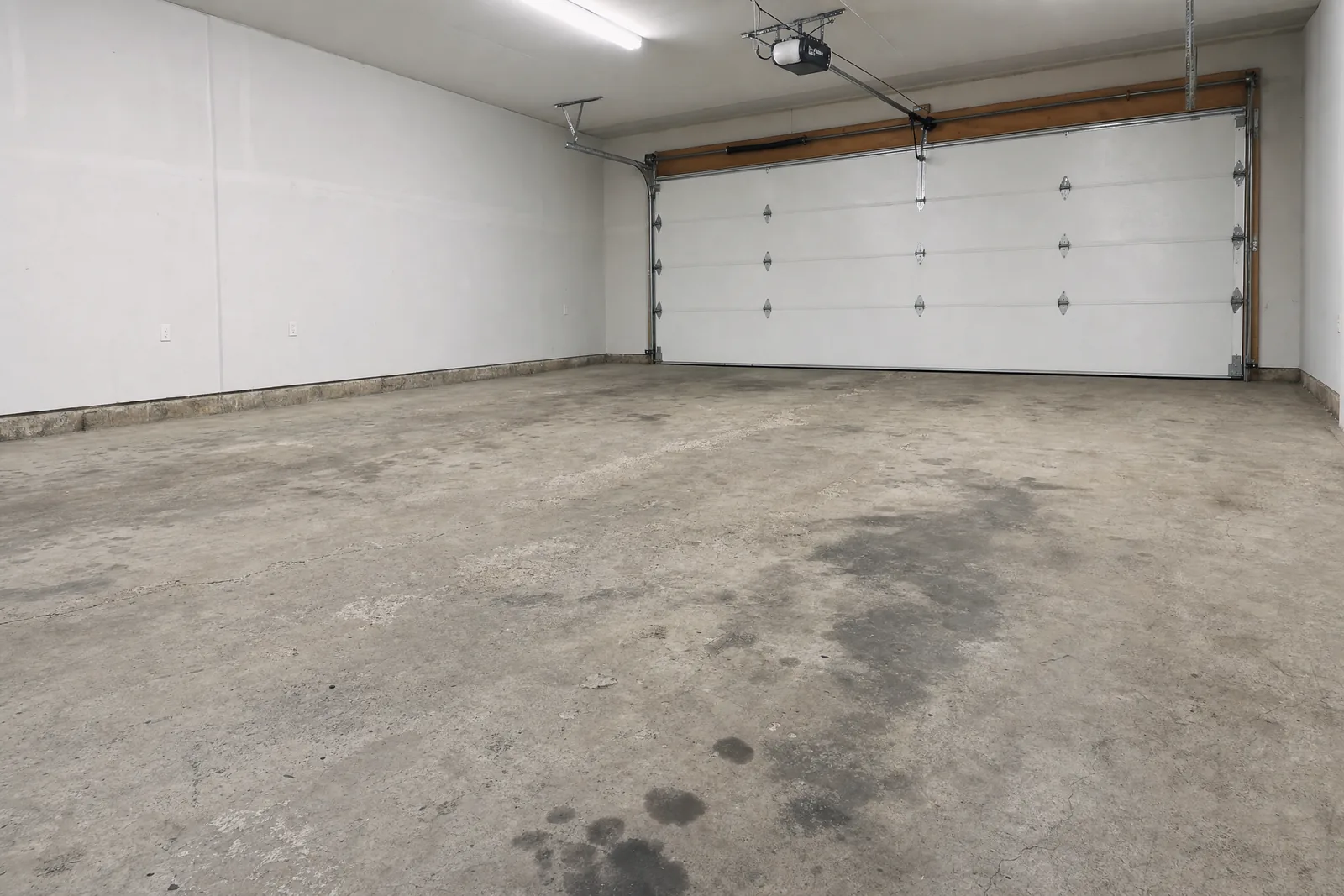
Every market has its own failure mode. Ours is a combination of chemistry and movement. Four things drive nearly every callback we see in Reno:
- Magnesium chloride. Brine tracked home from the passes attacks bare concrete directly and creeps under any coating that wasn't properly bonded at the edges. This is the number one killer of garage slabs in the Truckee Meadows.
- Freeze-thaw cycling. Cold clear nights and sunny days mean the slab crosses freezing over and over, sometimes daily for weeks. Water in the surface freezes, expands nine percent, and breaks the concrete apart from inside.
- Cold-slab application. Standard epoxy stops curing below about 55°F, and an unheated Reno garage sits under that from November through March. Coatings applied then never fully harden.
- High-altitude UV. At 4,500 feet there is less atmosphere overhead, so the sunlight reaching the first few feet inside your door is harsher than at sea level. Epoxy topcoats amber under it.
We cover all of this in detail on why garage floor coatings fail in Reno.
How a job actually runs
- Free on-site measure. We look at the slab, not just the square footage. Cracks, spalling, previous coatings and moisture all change the number.
- Moisture test. A sealed plastic sheet or calcium chloride test tells us whether vapor is moving up through the slab. If it is, you need a vapor-barrier primer or the floor will blister. More on testing.
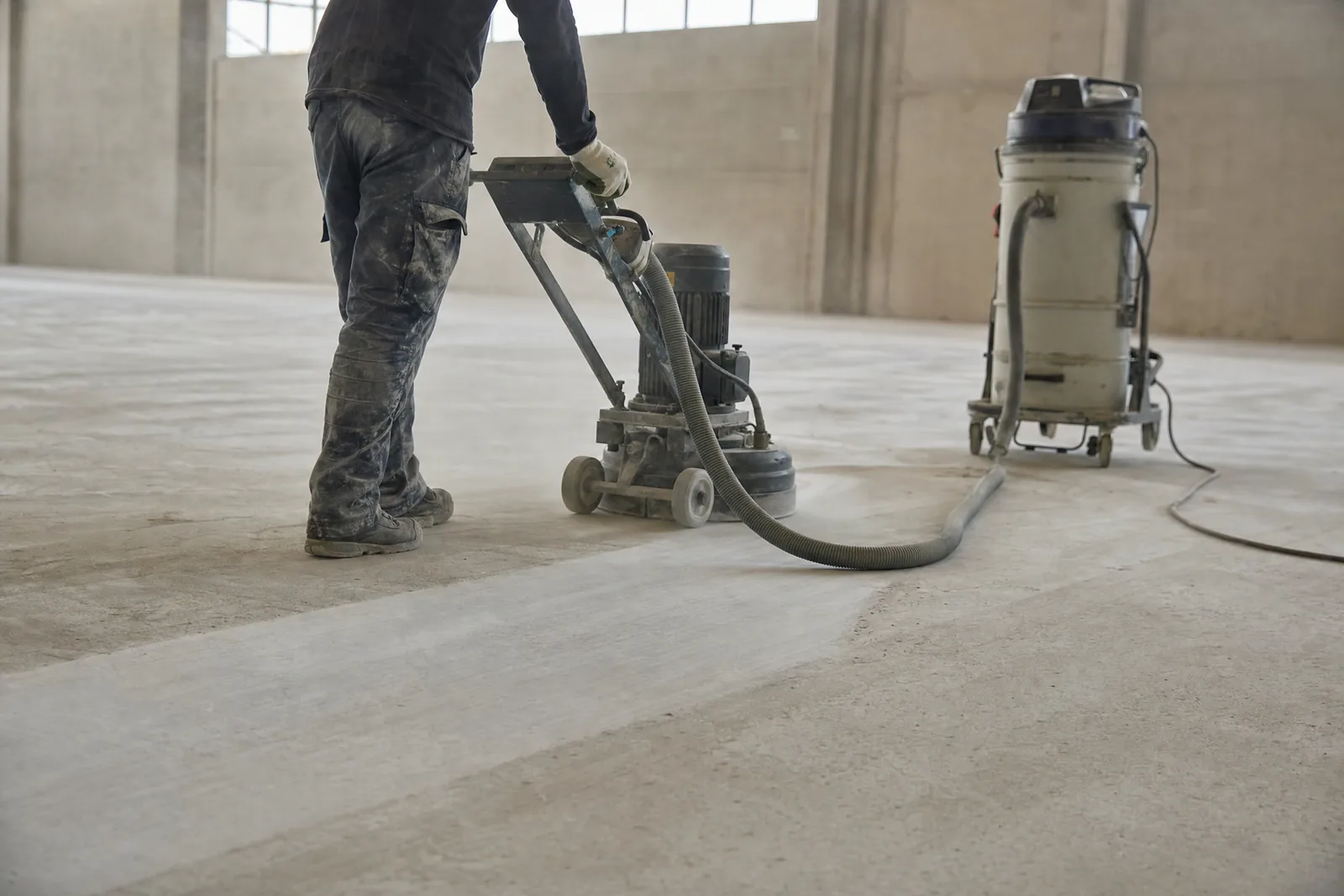
- Diamond grinding. Mechanical profile, dust-extracted. We do not acid etch. Why that matters.
- Repairs. Cracks routed and filled, spalls patched, control joints handled. Repair detail.
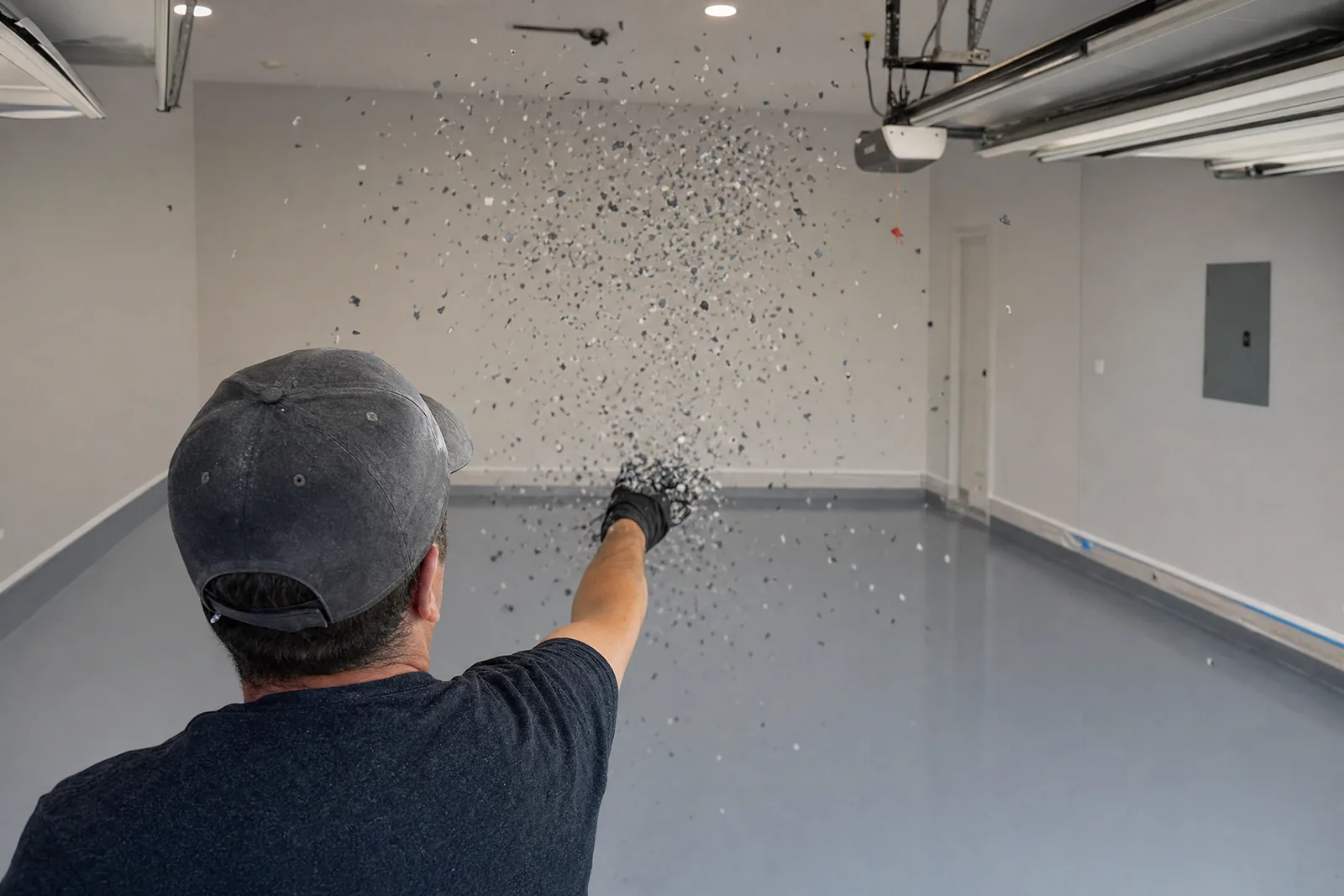
- Base coat and broadcast. Chips thrown to full refusal so the color is even edge to edge.
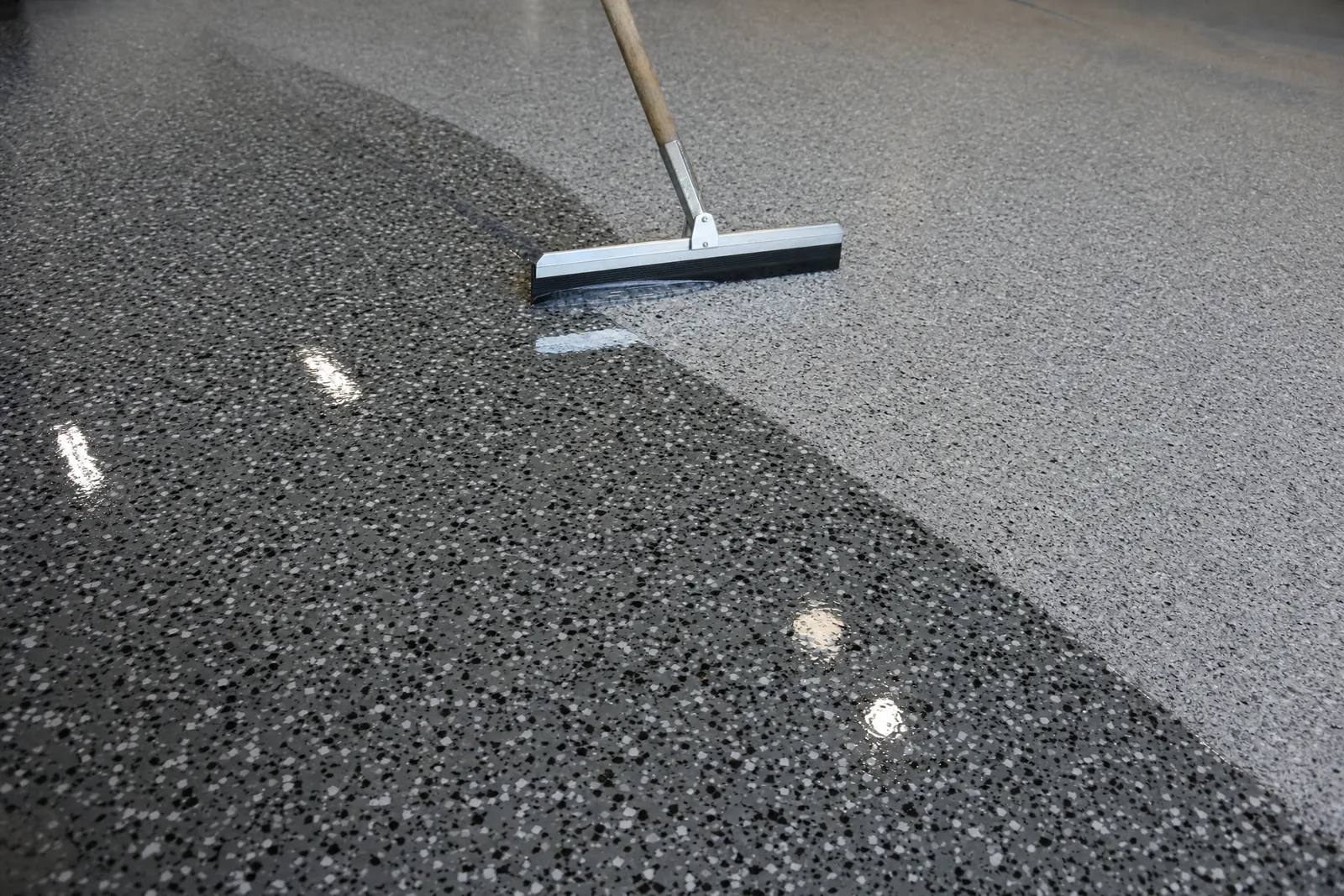
- Scrape and topcoat. Excess flake knocked down, then a clear polyaspartic topcoat.
What it costs
A standard two-car garage in Reno generally lands between $2,400 and $4,100 installed, depending on slab condition and the system you choose. Bigger spaces cost less per square foot; badly damaged slabs cost more because prep is where the labor goes. Our Reno cost guide breaks down the real numbers including what drives a quote up.
Where we work
Reno, Sparks, South Reno, Somersett, Spanish Springs, Caughlin Ranch, Damonte Ranch, Verdi and Carson City. See service areas for detail on each.
What a real quote should tell you
Garage floor coating is an unlicensed-adjacent trade in most of the country, which means the quality range between two contractors quoting the same garage is enormous. The price difference between a floor that lasts fifteen years and one that lasts fifteen months is often only a few hundred dollars, and it is almost entirely invisible on the day of install. Both floors look excellent when the crew drives away.
That is the uncomfortable part of this trade. You cannot inspect the work that matters. Once the topcoat is down, nobody can see whether the slab was ground or acid-washed, whether the flake went to refusal or was scattered thin, whether the edges were hand-ground or skipped. You are buying a process you will never see, which makes the questions you ask beforehand the only real quality control available to you.
A written quote should name the preparation method, the broadcast coverage, the specific topcoat product, and the moisture test result. If a quote is one line and one number, you have no way of comparing it to anything.
The four questions worth asking every contractor
Do you grind or acid etch?
The only acceptable answer is mechanical grinding. Acid etching produces a marginal profile, leaves residue that must be neutralised, and drives water into the slab immediately before coating. Every major manufacturer specifies mechanical preparation in their technical data.
Full broadcast or partial?
Full means chips thrown until the floor refuses more. Partial scatters them at thirty to fifty percent coverage. Both look fine on day one. Only one still looks even after five years of tyre traffic.
What is the topcoat, by product name?
Ask for the data sheet. In this climate the topcoat has to be aliphatic — polyaspartic or aliphatic polyurethane — or the strip inside your garage door will amber.
What did the moisture test read?
If nobody tested, you are carrying that risk. Most warranties exclude substrate moisture failure, and after the fact there is no way to establish whether the slab was ever suitable.
Slab conditions we see across Reno
Housing stock in this area falls into a few broad eras, and each brings its own slab characteristics. Knowing roughly what you have helps you read a quote.
| Era | Typical condition | What it usually means |
|---|---|---|
| Pre-1990 | Sound but heavily contaminated; oil deep in the surface | Aggressive grinding pass, sometimes degreasing first |
| 1990s–2000s | Generally good; some shrinkage cracking, occasional spalling at thresholds | Standard prep plus routine crack repair |
| 2010s | Good; frequently has a prior coating from the original owner | Adhesion testing, sometimes full removal |
| New build | Clean but often young | Confirm the pour date before anything else |
None of these are problems. They are variables, and a contractor who assesses them properly gives you a quote that holds. A contractor who quotes by square footage alone is guessing, and the guess gets corrected later as a change order.
How long the whole process takes
- First call — five minutes. We ask about the space, the slab age, and whether there is an existing coating.
- On-site measure — usually within a few days, takes about forty minutes. We measure, assess, and set a moisture indicator test.
- Written quote — same day or next. Specified line by line.
- Scheduling — typically one to three weeks out, longer in spring and autumn.
- Install — commonly a single working day for a standard two-car garage.
- Return to service — walk on it that evening, park on it in 24 to 72 hours.
Start to finish, most residential jobs run three to four weeks from first call to parking on the finished floor, and only one of those days involves any disruption to you.
Common questions
How long until I can park on it?
Foot traffic is usually possible the same evening. Vehicle traffic typically after 24 to 72 hours depending on the topcoat and the temperature. Polyaspartic cures faster than epoxy, which is one reason we lean on it here.
Parking too early is one of the few ways a homeowner can damage a good floor. We give you a specific time before we leave, not a range.
Do I need to empty the garage?
Yes, completely. We need clear access to every inch of slab including under shelving and against the walls. Most people move things into the driveway for the day or into a spare room. If you have built-in cabinets that can't move, tell us at the quote so we can plan the cut-in.
Will it be slippery?
A full-broadcast flake floor has meaningful texture from the chips themselves and is less slippery wet than bare sealed concrete. If you want more grip than that — common around pool decks or for anyone with mobility concerns — we add a polymer grit to the topcoat or use a quartz broadcast system instead.
Can you coat over my existing epoxy?
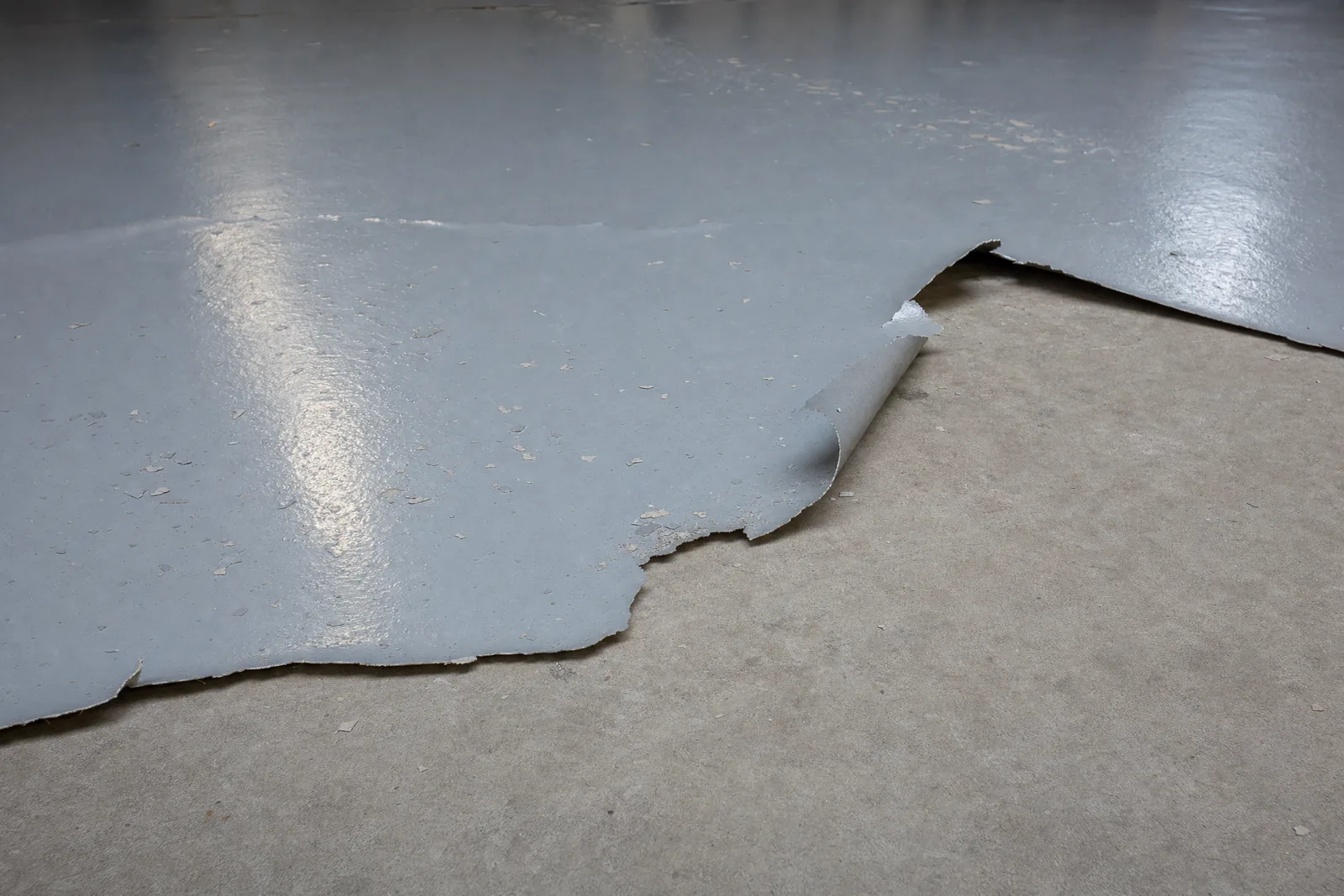
Sometimes. If the existing coating is well bonded across the whole floor, we can abrade and recoat. If any of it is peeling, delaminating or lifting under a tire, it all has to come off, because a new coating is only as good as what it's stuck to. We test adhesion at the quote rather than guessing.
Is a garage floor coating worth it in Reno?
For most homeowners here, yes, and the argument is stronger than in milder climates. Bare concrete in the Truckee Meadows takes brine all winter, then freezes and thaws through it. That is exactly the mechanism that produces the crumbling, pitted thresholds you see all over town.
It's a one-time cost against a slab you can't easily replace. The main reason not to do it is if your slab has active structural cracking, in which case the movement needs addressing first.
Ready for a floor that survives a Sierra winter?
Free on-site measure, honest assessment of your slab, and a written quote you can hold us to.