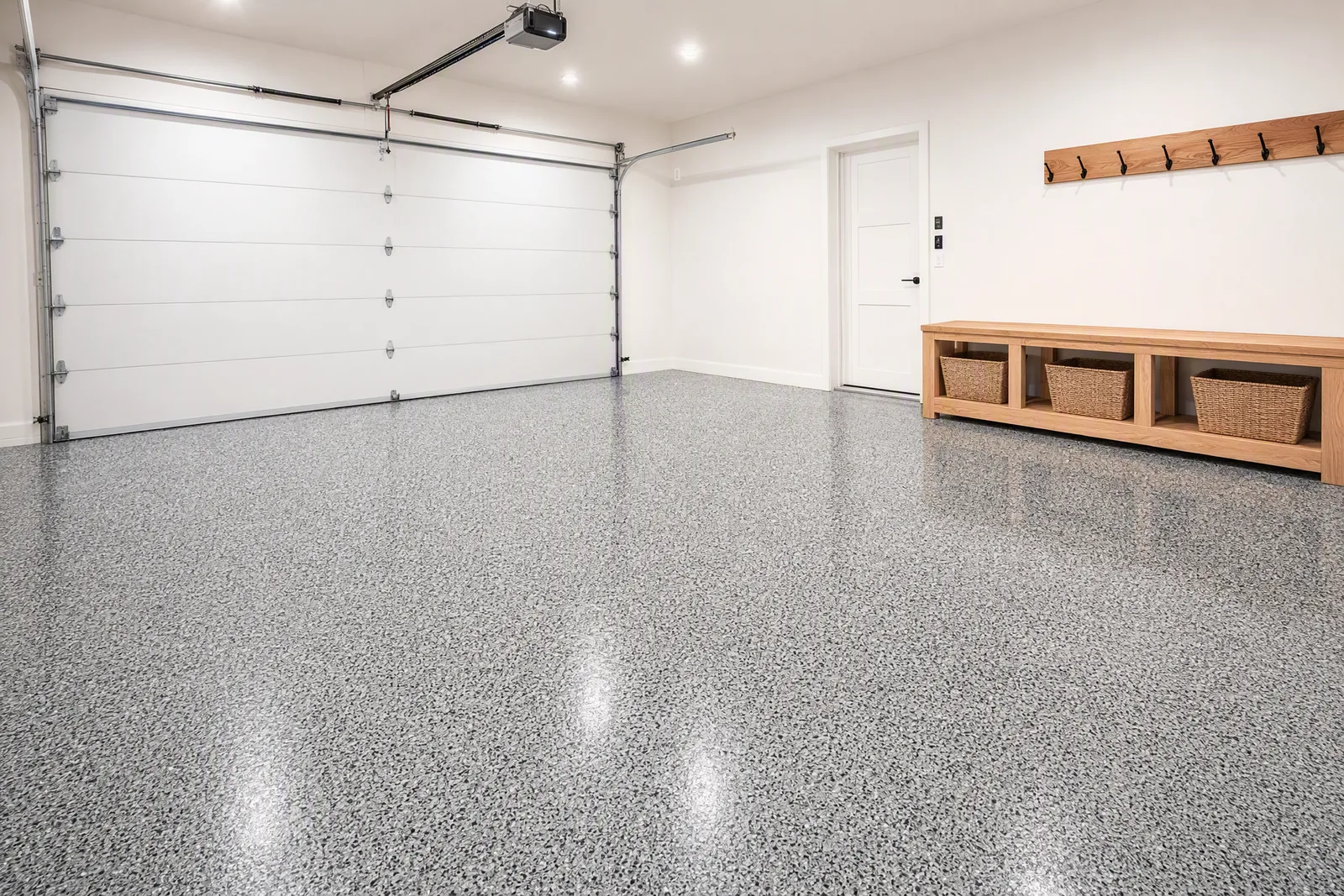
Epoxy is a two-part thermosetting resin. You mix a resin with a hardener, a chemical reaction takes place, and it cures into a hard plastic that is bonded to whatever it was poured over. That last part is the whole game. Epoxy doesn't stick to concrete because it's sticky — it sticks because it flows into a mechanically opened surface profile and locks in. If the slab was never opened up, you have a plastic sheet lying on a floor, waiting for a hot tire to peel it.
What we actually install
Almost nobody wants a pure epoxy floor, and we rarely recommend one. What people mean when they say "epoxy garage floor" is a hybrid system, and that's what we build:
| Layer | Product | Job it does |
|---|---|---|
| Primer | Penetrating epoxy or moisture-mitigating primer | Bonds into the ground profile; blocks vapor if the slab tests wet |
| Body coat | Pigmented epoxy or polyurea | Builds film thickness and carries the color |
| Broadcast | Vinyl flake to refusal | Color, texture, grip, and hiding power over slab defects |
| Topcoat | Polyaspartic, one or two coats | Abrasion resistance, chemical resistance, UV stability |
The topcoat is where Reno jobs are won or lost. Straight epoxy on top will amber under UV, and in a garage that shows up as a discolored band inside the door. Polyaspartic doesn't. See epoxy vs polyaspartic vs polyurea for the full comparison.
Which system belongs in your garage
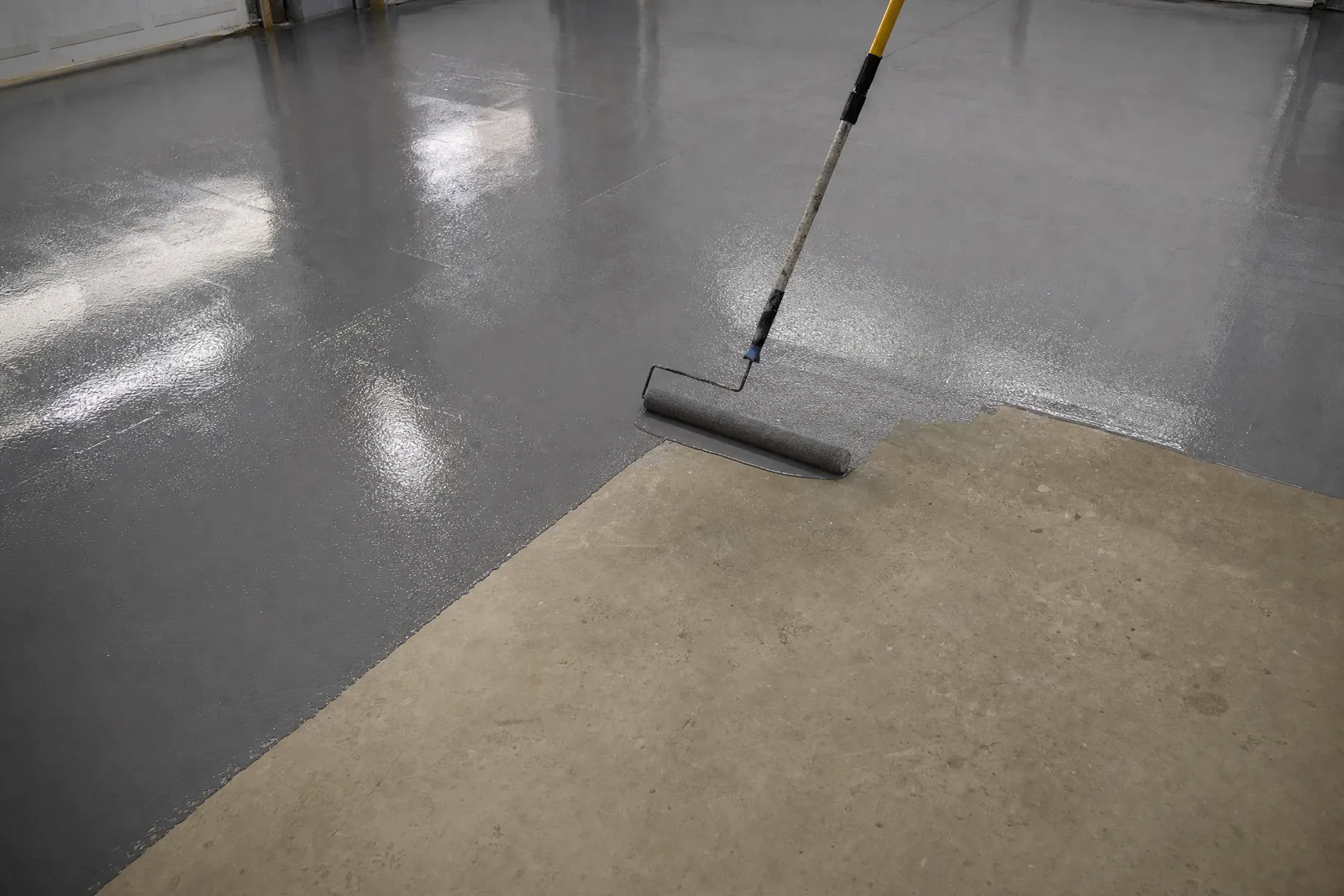
"Epoxy garage floor" is the search term, but it covers several different builds. This is the decision tree we walk customers through at the measure.
| If your priority is… | The build | Detail |
|---|---|---|
| Hiding a slab that has seen some life | Full-broadcast flake | Flake systems |
| A showpiece under good lighting | Metallic over a flat, sound slab | Metallic floors |
| Maximum traction, wet or barefoot | Quartz broadcast | Quartz systems |
| A clean uniform field, usually commercial | Solid colour, high build | Solid colour |
| Nothing that can ever delaminate | Polished concrete, no film at all | Polished concrete |
For roughly four out of five residential garages in Reno the answer is full-broadcast flake with a polyaspartic topcoat, and the reasons are practical rather than aesthetic. Colour options for every system are on the colours and flake blends page.
Preparation, briefly
Grinding, repair and cleanup take longer than everything else on a job combined, and that ratio is the clearest signal of whether a quote is real. We never acid etch. The full explanation — surface profiles, tooling, why edges fail first — is on concrete grinding and surface preparation.
Film thickness and why it decides everything
Coating durability is largely a function of how much material is between your tyres and the concrete, measured in mils — thousandths of an inch. This single number explains most of the performance gap between a professional floor and a kit floor, and almost nobody discusses it with homeowners.
| System | Typical dry film | Realistic life |
|---|---|---|
| Big-box DIY kit | 2–4 mils | 1–4 years |
| Budget contractor, partial broadcast | 8–12 mils | 4–7 years |
| Full broadcast flake with polyaspartic | 18–40 mils | 15–20 years |
| Industrial high-build | 40–125 mils | 20+ years under heavy use |
A sheet of paper is roughly 4 mils. A kit floor is about that thick, which is why it wears through in traffic paths so quickly. A full broadcast system is closer to a credit card, and the chips themselves carry much of the abrasion load rather than the resin.
What happens underneath during cure
Epoxy cures by chemical reaction, not evaporation. Resin and hardener react exothermically — the floor genuinely gets warm — and the polymer chains cross-link into a rigid thermoset. Three practical consequences follow from this:
- Mix ratio is not negotiable. Off-ratio material does not cure fully. It stays soft indefinitely, and no amount of waiting fixes it. This is a common failure in DIY work where someone mixes a partial batch by eye.
- Temperature drives the reaction. Hotter slab, faster cure, shorter working time. In Reno summer that window closes fast, which is why we start early and why an afternoon application in July is a warning sign.
- Full cure lags walkability by days. A floor you can walk on in eight hours does not reach full chemical hardness for about a week. Parking a vehicle at day two puts load on a floor that has not finished becoming what it will be.
Where the system is most likely to fail, in order
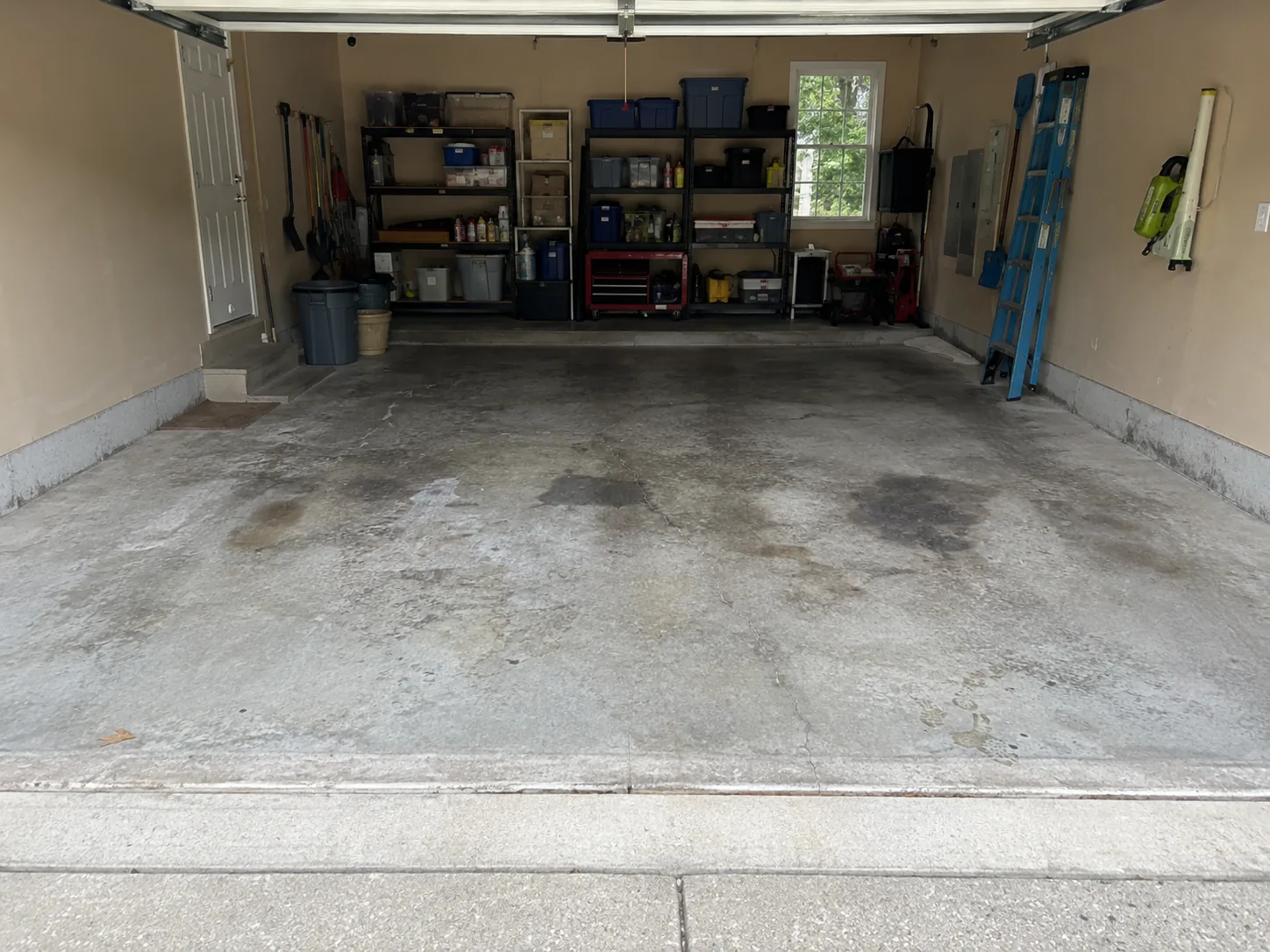
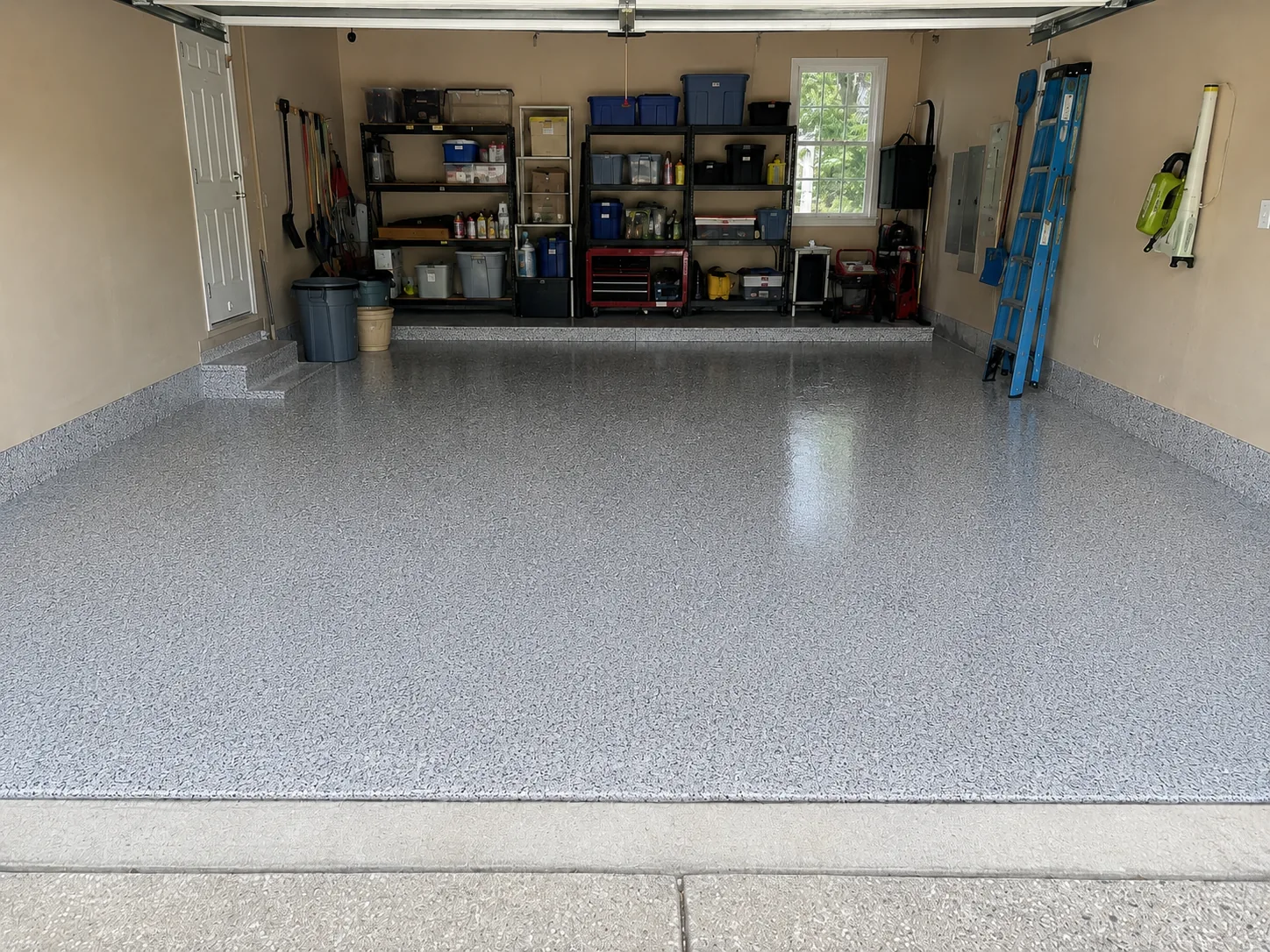
- Perimeter edges. A walk-behind grinder cannot reach the last inch against a wall. Hand grinding those edges is slow, awkward, and the first thing skipped under time pressure. Water and cleaning solution collect exactly there.
- The door threshold. Highest UV, highest abrasion, and where the coating has to terminate in a clean line. A sloppy termination chips within months.
- Control joints. Filled or honoured, both are valid, but they have to be a deliberate decision. Ignored joints crack through the finish.
- Repaired areas. A patch that was not ground flush before coating leaves a ridge, and the coating over a ridge is thinner and wears first.
Notice that three of the four are detail work rather than material choice. That is the honest summary of this trade: the product matters far less than whether someone took the time.
Common questions
How long does an epoxy garage floor last?
A properly prepped flake system with a polyaspartic topcoat should give you 15 to 20 years in a residential garage before it needs a recoat, and the recoat is a topcoat refresh rather than a teardown.
A poorly prepped floor can fail in a single summer. The variable is almost never the product — it's whether the slab was ground and whether it was tested for moisture first.
Is epoxy or polyaspartic better for a garage?
In this climate, a hybrid: an epoxy or polyurea body coat for build and bond, with a polyaspartic topcoat for UV and abrasion resistance. Pure epoxy ambers under sunlight and is softer under hot tires. Pure polyaspartic throughout is excellent but costs more and cures so fast it leaves very little working time.
Anyone selling you a single-product answer is describing their inventory, not your floor.
Can epoxy be applied over a cracked slab?
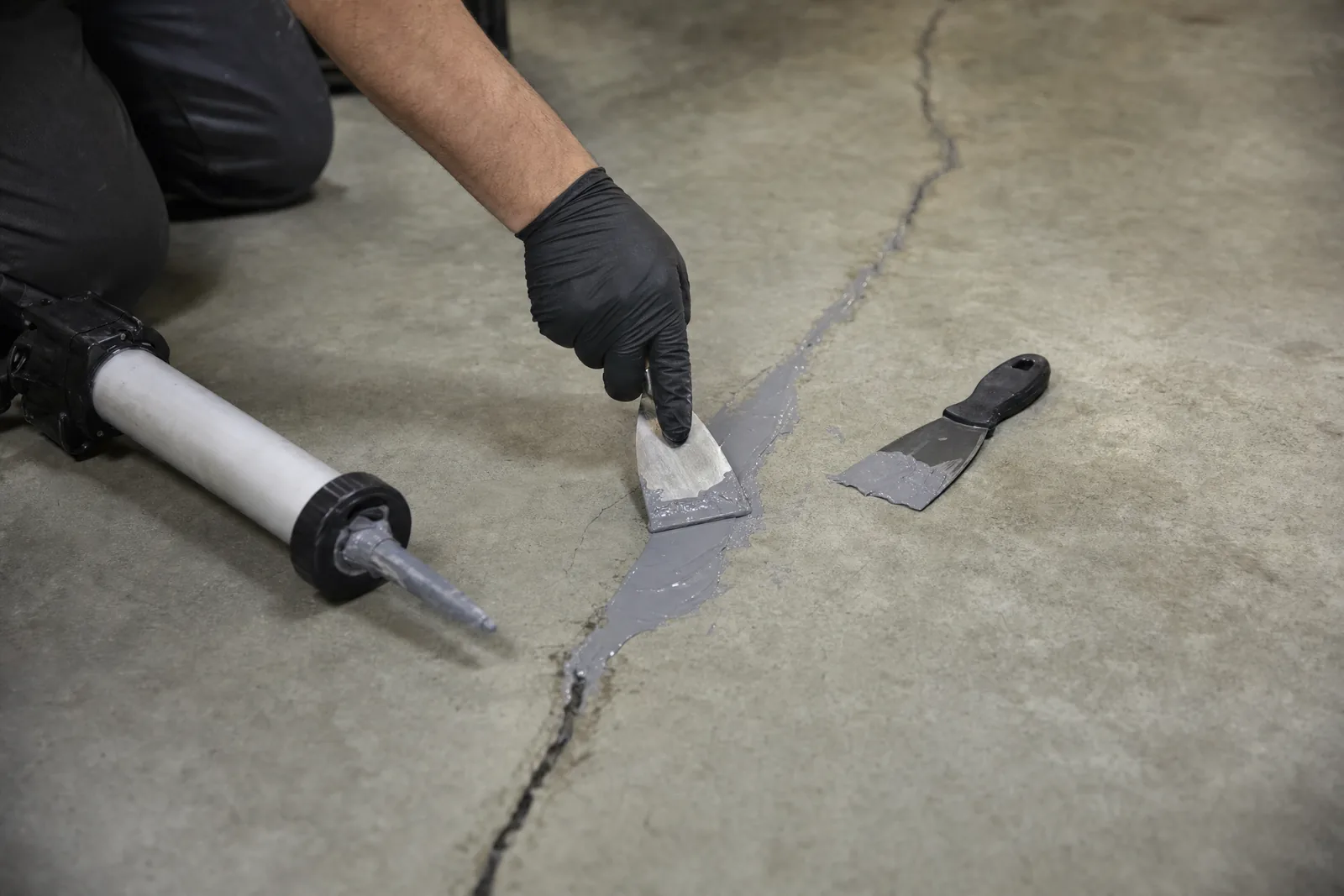
Yes, if the cracks are dormant. We rout them out, fill with a semi-rigid polyurea, and grind flush before coating. That gives a continuous surface with no visible line.
Active cracks — ones still moving from settlement or subgrade issues — are different. Coating over active movement just means the crack reappears through the finish. We'll tell you at the quote which kind you have.
What does it smell like and is it safe?
Modern epoxy and polyaspartic systems are low-VOC and far less pungent than the solvent-based products of twenty years ago, but there is still an odor during application and for a few hours after. We ventilate throughout.
If anyone in the house is pregnant, asthmatic, or unusually chemically sensitive, mention it when you book and we'll schedule around it and take extra ventilation measures.
Do you coat the garage door threshold?
Yes, and it's worth asking any contractor about. We terminate the coating in a clean line at the threshold, which is the highest-wear and highest-UV spot on the whole floor. A sloppy termination there is the first thing to chip, and it's the first thing a visitor sees.
Ready for a floor that survives a Sierra winter?
Free on-site measure, honest assessment of your slab, and a written quote you can hold us to.