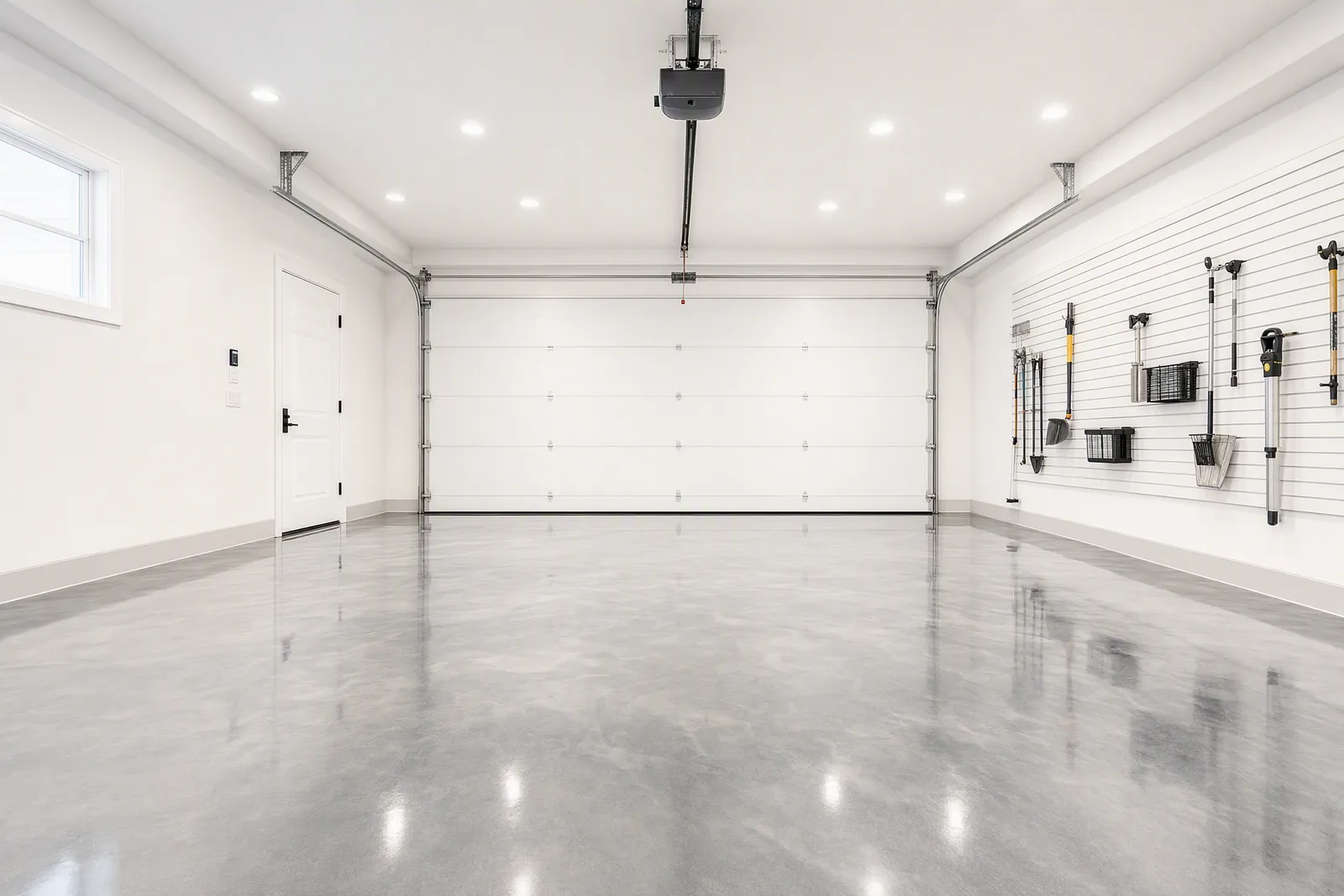
The short version
Epoxy is a rigid, high-build resin that bonds superbly and costs least. Polyurea is a fast, flexible elastomer used as a base coat. Polyaspartic is a slowed-down polyurea used as a topcoat, and it is the only one of the three that is UV stable.
For a Reno garage, the answer is almost always a hybrid: epoxy or polyurea below, polyaspartic on top.
Full comparison
| Property | Epoxy | Polyurea | Polyaspartic |
|---|---|---|---|
| UV stability | Poor — ambers | Varies | Excellent |
| Hot tire resistance | Moderate | Good | Excellent |
| Flexibility | Rigid | Elastomeric | Semi-flexible |
| Cure to foot traffic | 12–24 hrs | 1–2 hrs | 4–8 hrs |
| Cure to vehicle | 3–7 days | 24 hrs | 24–48 hrs |
| Working time | 30–60 min | Very short | 20–40 min |
| Low temp application | Stalls below 55°F | Wide range | Down to ~0°F |
| Film build per coat | High | Moderate | Lower |
| Relative cost | $ | $$ | $$$ |
Why not polyaspartic all the way through?
You can, and some premium systems do. Two reasons we usually don't: it costs considerably more, and its very short working time makes a thick body coat difficult to lay off cleanly. An epoxy or polyurea body coat gives you build and bond economically, and the polyaspartic does its real work on top where UV and abrasion happen.
Why not epoxy all the way through?
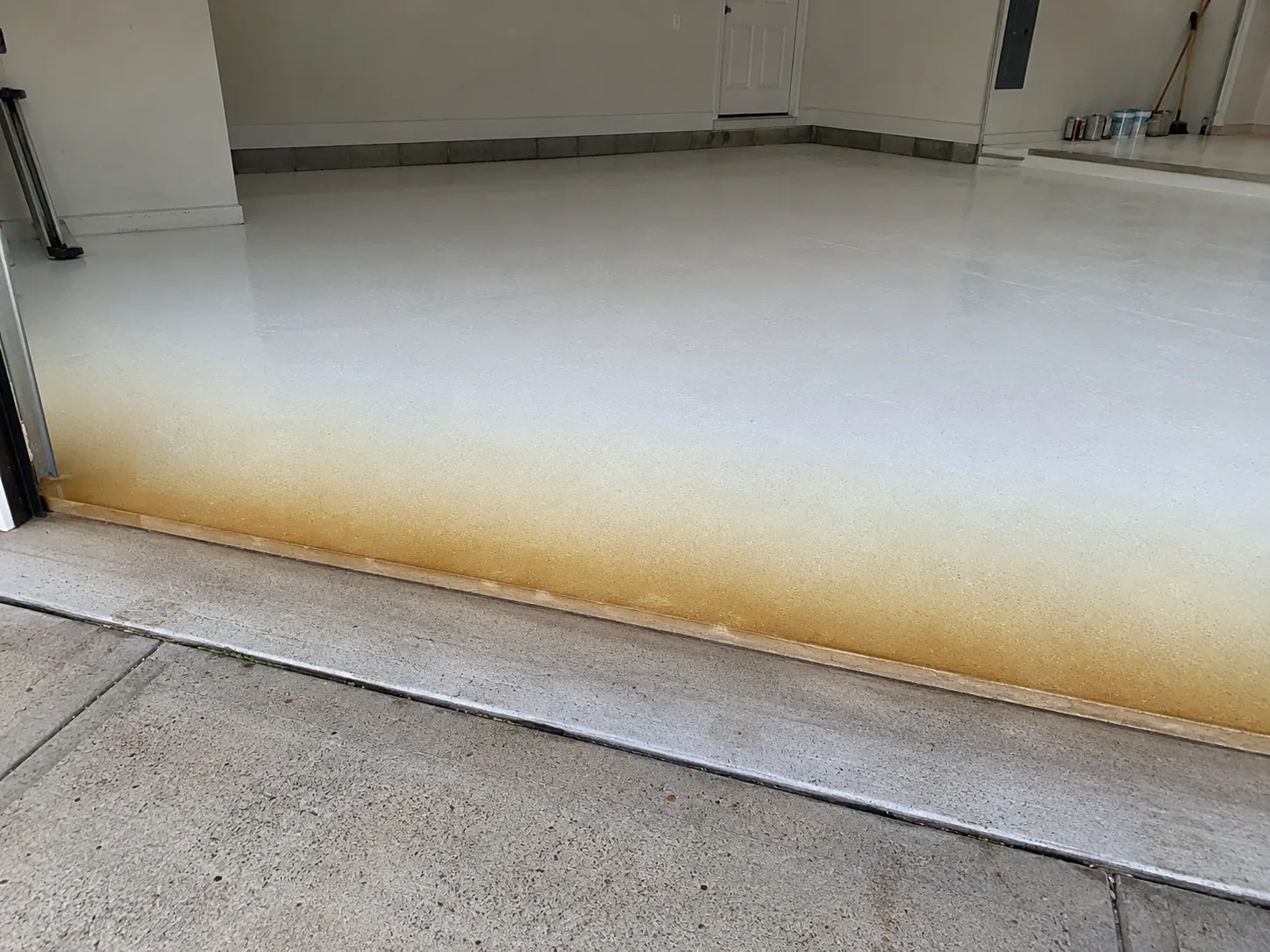
Because of the door. Any part of a Reno garage floor that sees sunlight will amber under an epoxy topcoat, and it shows as a discoloured band with a sharp edge. It's the most common cosmetic complaint we hear about floors installed by others.
What to ask a contractor
"What is the topcoat, specifically?" is a better question than "is this epoxy or polyaspartic?" Many companies market a "polyaspartic system" where only a thin final coat is polyaspartic — which is fine and is what we do — but some market it where the polyaspartic content is negligible. Ask for the product data sheet. A contractor who won't share it is telling you something.
Aromatic versus aliphatic, and why it decides the topcoat
The UV difference between these products is not a formulation quality issue — it is structural chemistry, and understanding it makes the choice obvious.
Aromatic resins contain benzene ring structures. Those rings absorb ultraviolet energy, and the absorbed energy breaks bonds, producing chromophores that appear as yellowing. Standard epoxy is aromatic. It will amber under UV, and no additive fully prevents it.
Aliphatic resins have straight-chain structures with no aromatic rings. There is nothing for UV to attack in the same way, so colour holds. Polyaspartics and aliphatic polyurethanes are built this way, which is precisely why they are used as exterior and sun-exposed topcoats across the entire coatings industry, not just in flooring.
This is why "UV resistant epoxy" should be read carefully. It may be more resistant than standard epoxy. It is still aromatic.
Cure chemistry and what it means practically
| Epoxy | Polyurea | Polyaspartic | |
|---|---|---|---|
| Reaction | Amine + epoxide | Amine + isocyanate | Aspartic ester + isocyanate |
| Speed | Slow, controllable | Extremely fast | Moderated, adjustable |
| Moisture sensitivity during cure | Can blush in humidity | Low | Low |
| Temperature floor | Stalls below ~55°F | Very wide | Down to ~0°F |
| Recoat window | Wide, forgiving | Very narrow | Narrow |
The recoat window row matters more than it looks. Miss it on an epoxy and you can usually abrade and continue. Miss it on a polyaspartic and the surface has to be mechanically abraded before anything else will bond, which on a large floor is a serious problem. This is another reason crew experience with these specific products matters.
Cost in context
The premium for polyaspartic is frequently overstated in conversation. It applies to one layer of a multi-layer system, and material is only 20–30% of the job.
| Build | Typical 2-car | Difference |
|---|---|---|
| Epoxy base + epoxy topcoat | $2,400 | — |
| Epoxy base + polyaspartic topcoat | $3,030 | +26% |
| Polyurea base + polyaspartic topcoat | $3,600 | +50% |
| Full polyaspartic build | $4,400 | +83% |
The middle option is where most Reno homeowners land, and we think it is genuinely the right answer for the majority of garages here. The full polyaspartic build is excellent and hard to justify unless the space has an unusual requirement.
Situations where plain epoxy is the right call
To be fair to it: a fully enclosed basement or interior storage room with no sunlight and no vehicle traffic has none of the conditions that punish epoxy. There, a good epoxy topcoat performs nearly identically for meaningfully less money, and recommending polyaspartic would be selling you something you do not need. The garage is a different environment, and that is where the argument lives.
Common questions
Is polyurea the same as polyaspartic?
Chemically they're the same family — polyaspartic is a polyurea made with a slower-reacting component so it stays workable long enough to apply by hand.
In practice the words describe different roles: polyurea for base coats, polyaspartic for topcoats. When a company says 'polyurea polyaspartic system' they usually mean both, used where each belongs.
Which lasts longest in a Nevada garage?
A polyaspartic-topped hybrid, comfortably. The failure modes here are UV and heat, and that's precisely where polyaspartic outperforms.
But prep still dominates. A well-prepped epoxy floor will outlast a badly-prepped polyaspartic one every time. Product choice is the second variable, not the first.
Is polyaspartic worth double the price?
It usually isn't double — the topcoat is one layer of a multi-layer system, so the realistic premium is 15 to 30 percent on the whole job.
At that number, in this climate, we think yes. If you were coating an interior basement that never sees sun or vehicles, the argument gets much weaker.
Ready for a floor that survives a Sierra winter?
Free on-site measure, honest assessment of your slab, and a written quote you can hold us to.