We get called to look at failed floors regularly. Almost all of them fall into four categories, and every one is tied to how a high-desert winter at 4,500 feet treats concrete.
1. Magnesium chloride from mountain driving
NDOT treats I-80, the Mt Rose Highway and the Spaghetti Bowl with magnesium chloride brine rather than rock salt, because it stays effective at lower temperatures. That is good for the roads and hard on your garage. Anyone driving to Mt Rose, Northstar or over Donner brings that brine home packed into wheel wells and undercarriage, where it drips onto the slab and sits.
Mag chloride is more aggressive than rock salt in two ways. It remains liquid at temperatures where rock salt has stopped working, so it stays in contact with your floor far longer. And it reacts with calcium hydroxide in concrete to form a compound that expands as it grows, effectively breaking the slab apart from inside the pore structure.
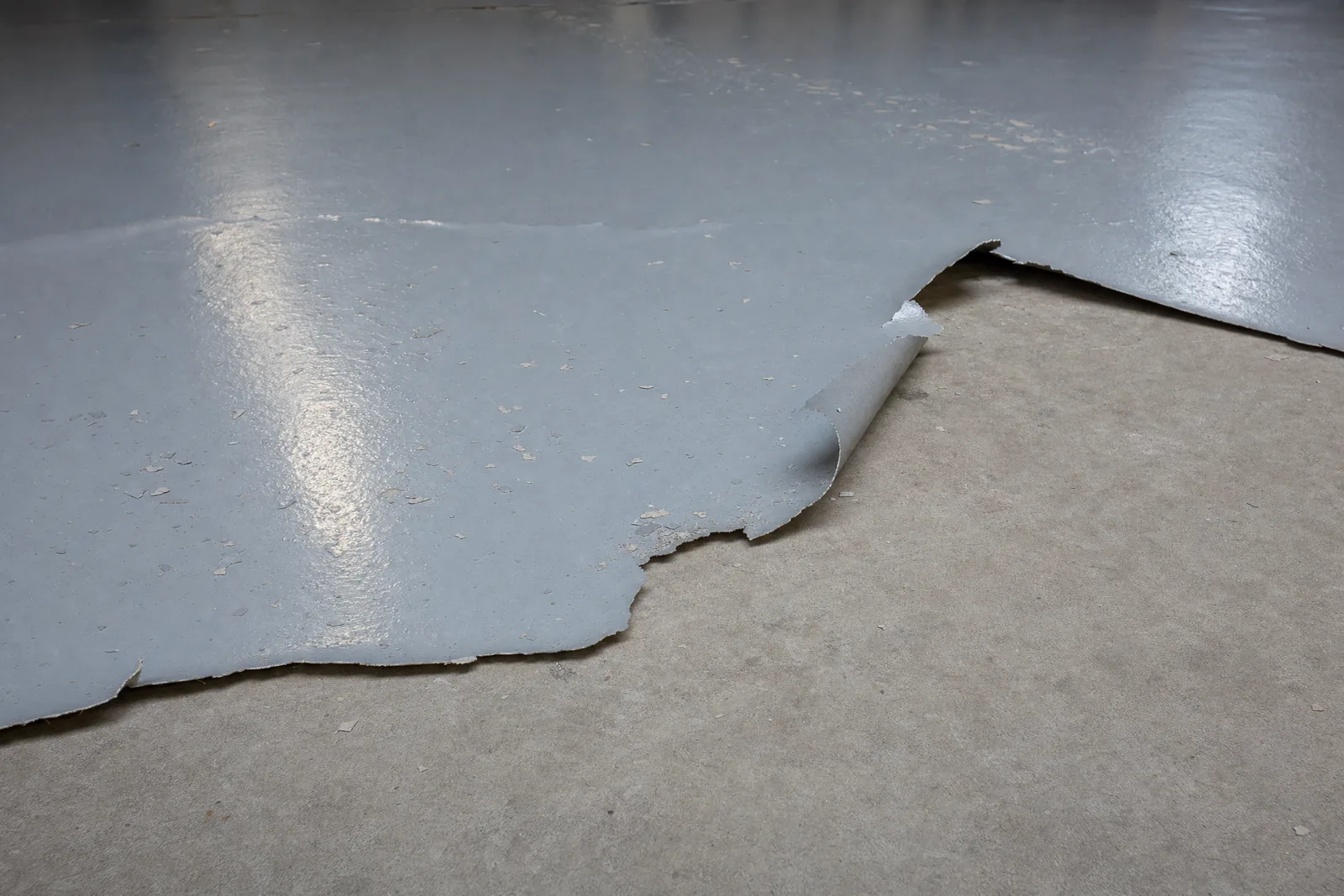
How to avoid it. A properly ground perimeter and a thick, clean termination at the threshold, because that is the route brine takes underneath a coating. A chemically resistant polyaspartic topcoat. And rinse the floor a few times over the season — it costs nothing and it is the single most effective thing a homeowner here can do.
2. Freeze-thaw cycling, and a lot of it
Reno gets more freeze-thaw cycles than most genuinely cold cities do, and the reason is counter-intuitive. Places that stay frozen all winter cycle rarely. Reno's high-desert climate produces cold clear nights well below freezing followed by sunny days that push above it — so the slab crosses the freezing point over and over, sometimes daily for weeks.
Each crossing, water that has soaked into the top few millimetres of concrete freezes and expands by roughly nine percent, prising the surface apart. That is why so many Truckee Meadows garage thresholds are pitted and crumbling while the middle of the floor looks fine.
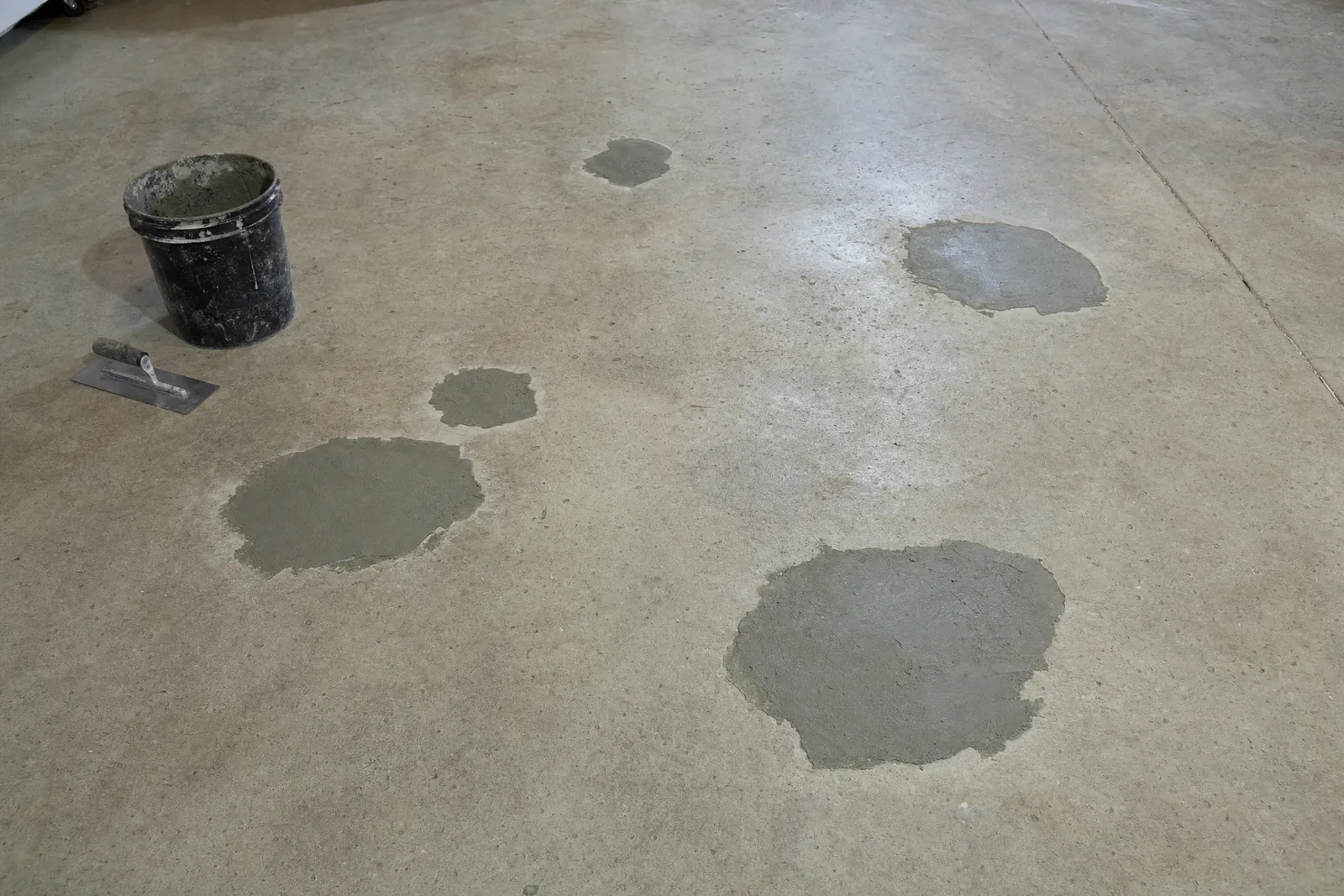
How to avoid it. Cut spalled areas back to sound concrete and repair before coating, never over. Keep water off the slab — a working garage door bottom seal matters more here than most people realise, especially with snowmelt running off a parked vehicle.
3. Applying to a cold slab
This is the one that catches contractors out, and it produces failures that look mysterious.
Standard epoxy effectively stops curing below about 55°F. An unheated Reno garage sits below that from roughly November through March, and the slab itself — a large thermal mass in contact with cold ground — runs colder than the air and lags well behind it in spring. A coating applied in those conditions may skin over and look finished while never reaching full cross-link density. It stays soft, and everything else on this page then damages it easily.
How to avoid it. Either heat the space and hold it through cure, or use a polyaspartic system, which cures at temperatures near freezing. This is the strongest practical argument for polyaspartic in this market and the main reason we lean on it here. A contractor willing to put standard epoxy down in an unheated garage in January is telling you something.
4. High-altitude UV
Reno sits at roughly 4,500 feet, and ultraviolet intensity rises meaningfully with elevation — there is simply less atmosphere overhead to absorb it. Combine that with over 250 sunny days a year and any part of your floor that sees daylight gets a harder UV dose than the same floor would at sea level.
Epoxy is aromatic chemistry. Under UV it ambers, and in a garage that shows as a discoloured band across the first few feet inside the door with a sharp line where the sunlight stops.
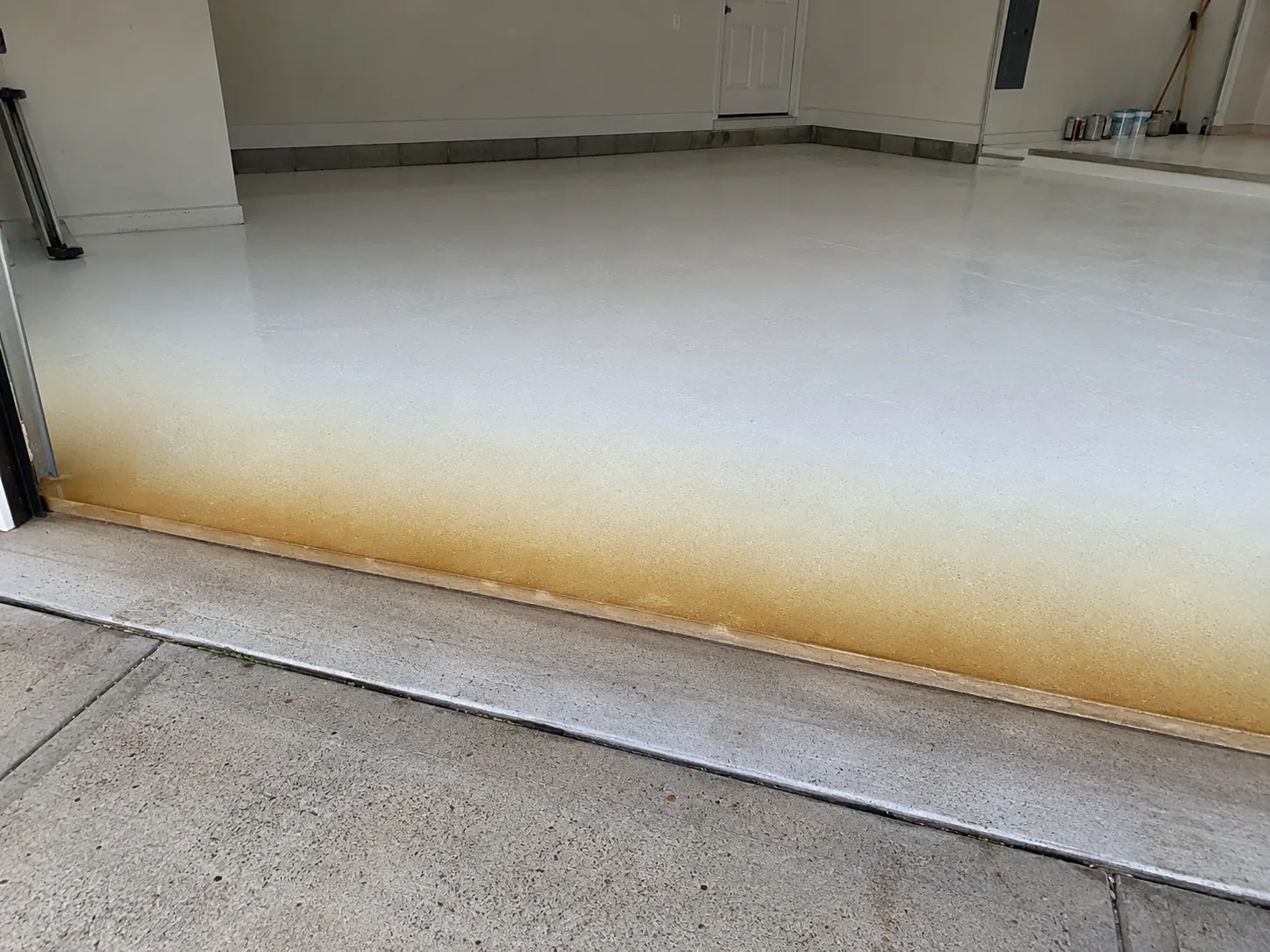
How to avoid it. An aliphatic topcoat — polyaspartic or aliphatic polyurethane. There is no version of standard epoxy that solves this.
Two failures that are not climate related
Perimeter delamination
The floor looks perfect across the open field and is lifting along the walls. A walk-behind grinder cannot reach the last inch or two, and hand grinding that perimeter is slow, uncomfortable work. Skip it and you have unprepared concrete exactly where snowmelt and brine collect. In this climate that is the worst possible place to cut a corner.
Off-ratio material
Two-part resins cure by chemical reaction and the mix ratio is not approximate. Material mixed by eye, or a partial batch measured by guess, never fully cross-links. It stays softer than specification indefinitely, which compounds every other problem on this page.
What a failure timeline usually looks like
| When it shows | Most likely cause |
|---|---|
| Days to weeks | Off-ratio mix, or applied to a slab below cure temperature |
| First winter | Brine working under a weak edge or threshold |
| 3–12 months | Inadequate surface profile; the bond was marginal from the start |
| 1–2 years | Freeze-thaw damage at a failed threshold; moisture drive from below |
| 2–4 years | UV ambering becoming obvious under an epoxy topcoat |
| 10+ years | Normal wear. This is a recoat, not a failure |
The pattern worth noticing: almost everything before year three traces to installation rather than to the product or to how you used the floor.
Diagnosing your own floor
| What you see | Most likely cause |
|---|---|
| Lifting at the threshold and creeping inward | Chloride attack under a weak edge |
| Pitted, crumbling concrete at the door | Freeze-thaw damage to the slab itself |
| Soft or tacky floor that never hardened | Applied to a cold slab, or mixed off-ratio |
| Yellow-brown band near the door | UV ambering of an epoxy topcoat |
| Round raised bubbles across the field | Moisture drive from below |
| Large sheets lifting cleanly, smooth concrete underneath | Inadequate prep, no mechanical profile |
| Coating gone at the perimeter only | Edges never ground |
Send us a photo and we'll tell you which of these you're looking at, whether or not you hire us. The diagnosis is usually obvious to someone who sees these weekly, and it changes what you should be asking other contractors.
If your floor is failing now
- Photograph it — wide shot plus close-ups of the failure edge.
- Find your paperwork. If it is under five years old there may be a live warranty, and that conversation should happen before you pay anyone else.
- Do not coat over it. Whatever it costs to remove properly, it costs more to remove twice.
- Establish the cause before the fix. A brine failure recoated without fixing the edge detail will simply fail at the same edge.
The uncomfortable summary
Almost none of these are product failures. The coatings sold today are excellent, and even mid-tier products perform well when installed correctly. What fails is process: the slab was not ground, or the crew applied epoxy to a 45-degree slab in February, or nobody specified an aliphatic topcoat.
That is genuinely good news for you as a buyer, because it means the questions that predict a good outcome are answerable before you sign anything.
Two failure modes that are not climate related
The four above are the Reno-specific ones. Two more account for most of what remains, and they are pure workmanship.
Perimeter delamination
The floor looks perfect across the open field and is lifting along the walls. This is the signature of skipped edge grinding — a walk-behind machine cannot reach the last inch or two, and hand grinding that perimeter is slow, uncomfortable work. Skip it and you have unprepared concrete exactly where water and cleaning solution collect.
It is also the easiest failure to spot early. Look at the last inch against your wall. If the coating looks thinner there, or you can see where the machine stopped, that is what you are looking at.
Off-ratio or cold-cured material
Two-part resins cure by chemical reaction, and the ratio is not approximate. Material mixed by eye, or mixed in a partial batch without measuring, does not fully cross-link. It stays soft indefinitely — not tacky necessarily, but softer than specification, which makes it far more vulnerable to everything else on this page. Hot tire pickup on a floor that should have resisted it often traces back here.
What a failure timeline usually looks like
| When it shows | Most likely cause |
|---|---|
| Days to weeks | Off-ratio mix, applied over a wet or contaminated slab, or parked on too early |
| 3–12 months | Inadequate profile. The bond was marginal from the start and thermal cycling finished it |
| 1–2 years | Moisture drive, or hot tire pickup on an under-specified product |
| 2–4 years | UV ambering becoming obvious; thin-build wear in traffic paths |
| 10+ years | Normal wear. This is a recoat, not a failure |
The pattern worth noticing: almost everything before year three traces to installation rather than to the product or to how you used the floor.
If your floor is failing now
- Photograph it — wide shot plus close-ups of the failure edge.
- Find your paperwork. If it is under five years old there may be a live warranty, and that conversation should happen before you pay anyone else.
- Do not coat over it. Whatever it costs to remove properly, it costs more to remove twice.
- Establish the cause before the fix. A moisture failure recoated without mitigation will simply blister again.
Send us the photos either way. We will tell you which of these you are looking at, whether or not you hire us — and knowing changes what you should be asking whoever quotes it.
The uncomfortable summary
Almost none of these failures are product failures. The coatings sold today are excellent, and even mid-tier products perform well when installed correctly. What fails is process: the slab was not ground, or not tested, or the topcoat was chosen on price, or the crew was working too fast in too much heat.
That is genuinely good news for you as a buyer, because it means the questions that predict a good outcome are answerable before you sign anything.
Common questions
Can you coat my garage in winter?
With a polyaspartic system, yes — it cures at temperatures near freezing, which is exactly why we use it here. With standard epoxy in an unheated garage, no, and anyone who says otherwise is risking your floor.
We measure slab temperature, not air temperature. The slab is a large thermal mass sitting on cold ground and it runs colder than the room, particularly in early spring when the air has warmed but the concrete has not caught up.
My floor is only two years old and it's already lifting. Is that normal?
No. A properly installed floor should go 15 years or more before it needs anything beyond a topcoat refresh. Failure at two years points to prep or application conditions, not wear.
In this market the two usual causes are brine getting under a poorly terminated edge, or the floor having been applied to a slab that was too cold to cure properly. Where it started tells you which.
Does mag chloride really damage a coated floor?
It damages a badly coated floor. A sound, properly bonded polyaspartic system handles chloride exposure without issue — that is what gets specified for commercial entryways in snow markets.
What brine exploits is a weak bond. Any gap at an edge, threshold or joint gives it a route underneath, and once it is under the film it lifts it from below where the coating has no defence.
Should I rinse my garage floor in winter?
Yes, and it is the highest-value maintenance you can do here. A few rinses across the season stops chloride concentrating as snowmelt evaporates off the slab.
If you ski or drive over the passes regularly, do it more often. That is where the brine is coming from, and it arrives in quantity.
Ready for a floor that survives a Sierra winter?
Free on-site measure, honest assessment of your slab, and a written quote you can hold us to.