Dormant cracks vs active cracks
This distinction decides everything. A dormant crack has finished moving — typically shrinkage cracking from the original cure. It can be filled and will stay filled. An active crack is still moving, driven by settlement, subgrade issues or thermal cycling. Fill it and it will reopen, and the coating over it will split along the same line.
We assess this at the quote. If a crack is active, the honest answer is that the movement needs addressing before a coating makes sense — and that's a foundation conversation, not a flooring one.
How we repair
- Rout. The crack is cut open into a clean V or U channel. Filling a hairline crack without opening it just puts material on the surface.
- Clean. Vacuumed out completely. Dust in the channel means no bond.
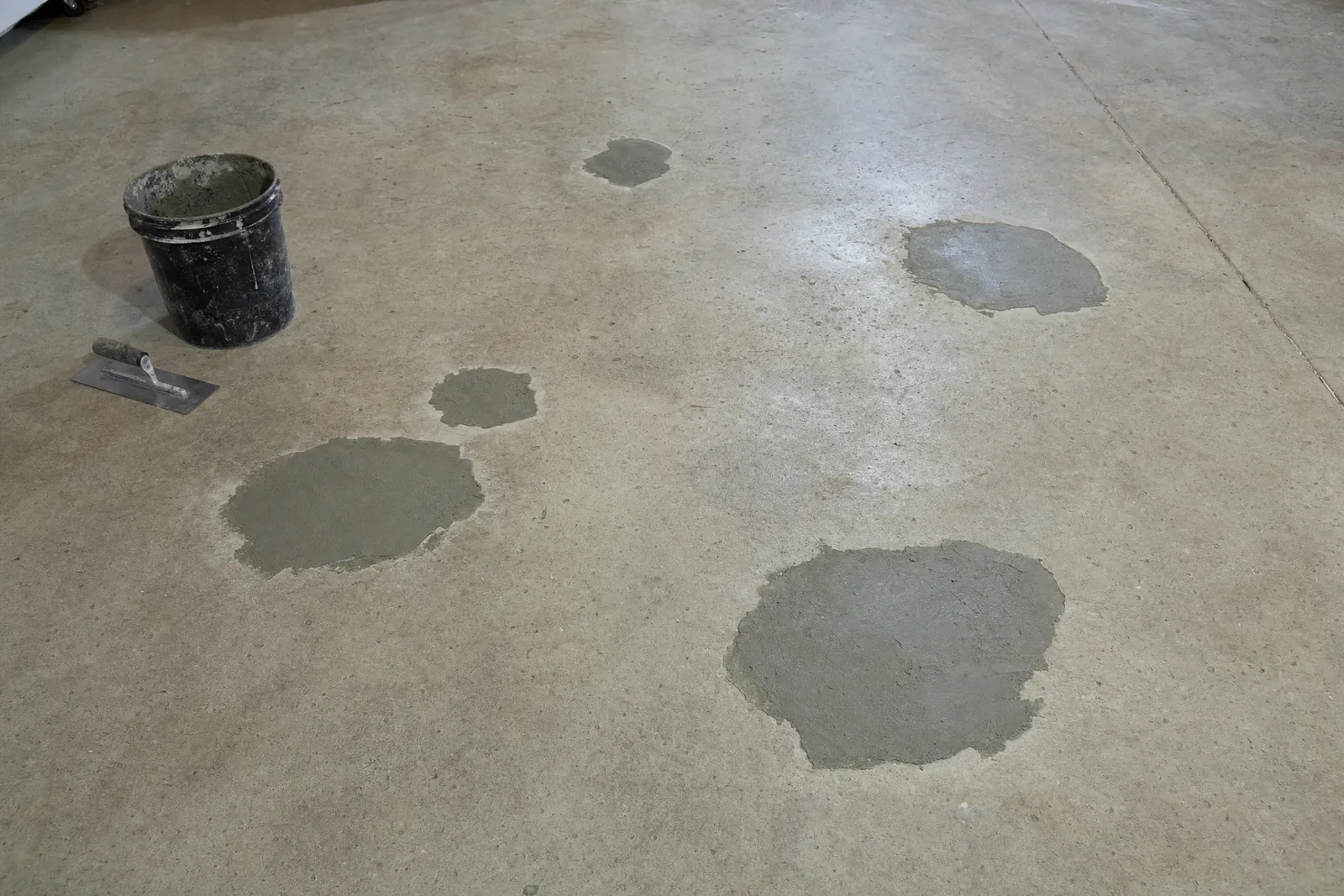
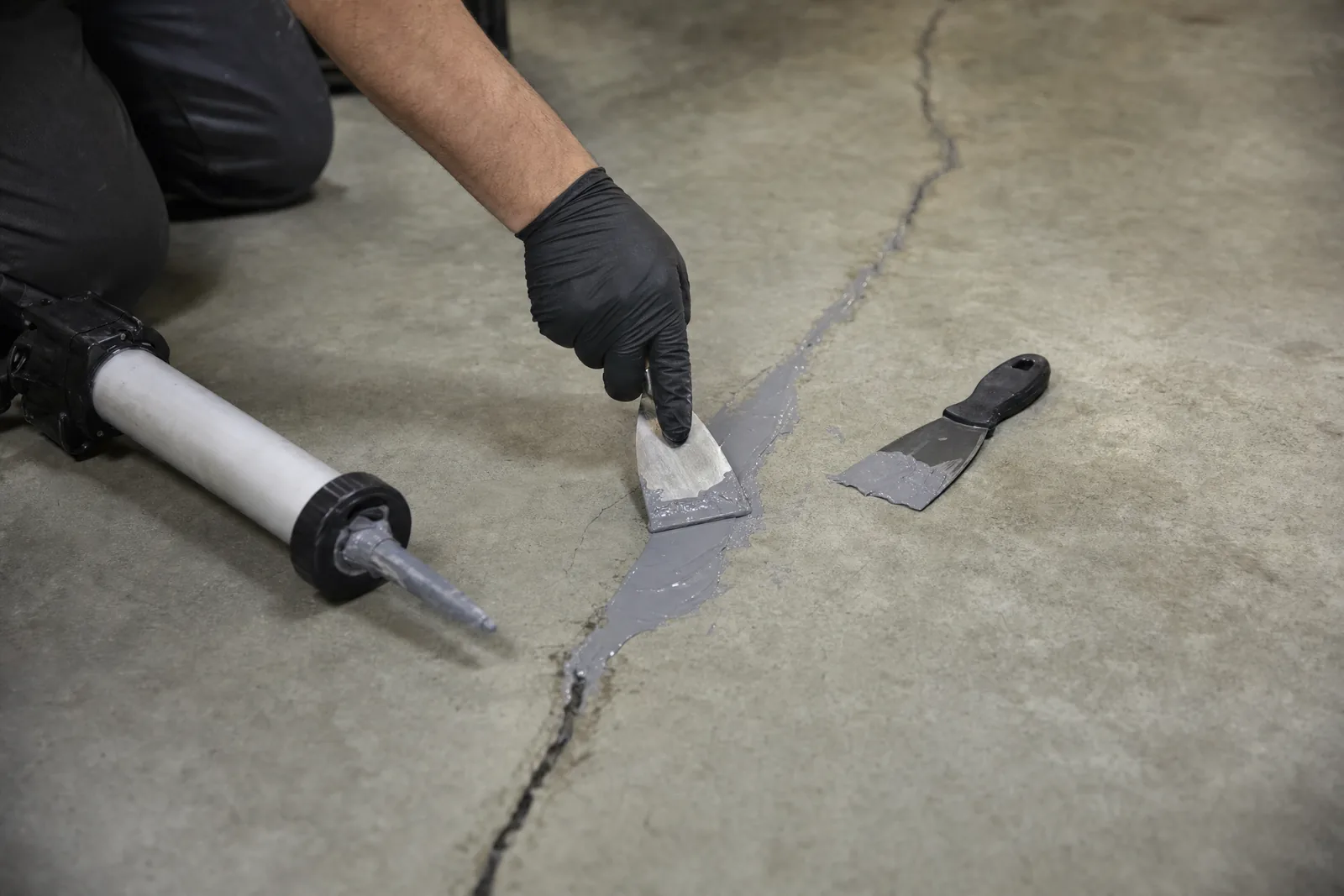
- Fill. Semi-rigid polyurea for cracks — it stays slightly flexible and takes load. Cementitious or epoxy mortar for spalls and larger patches.
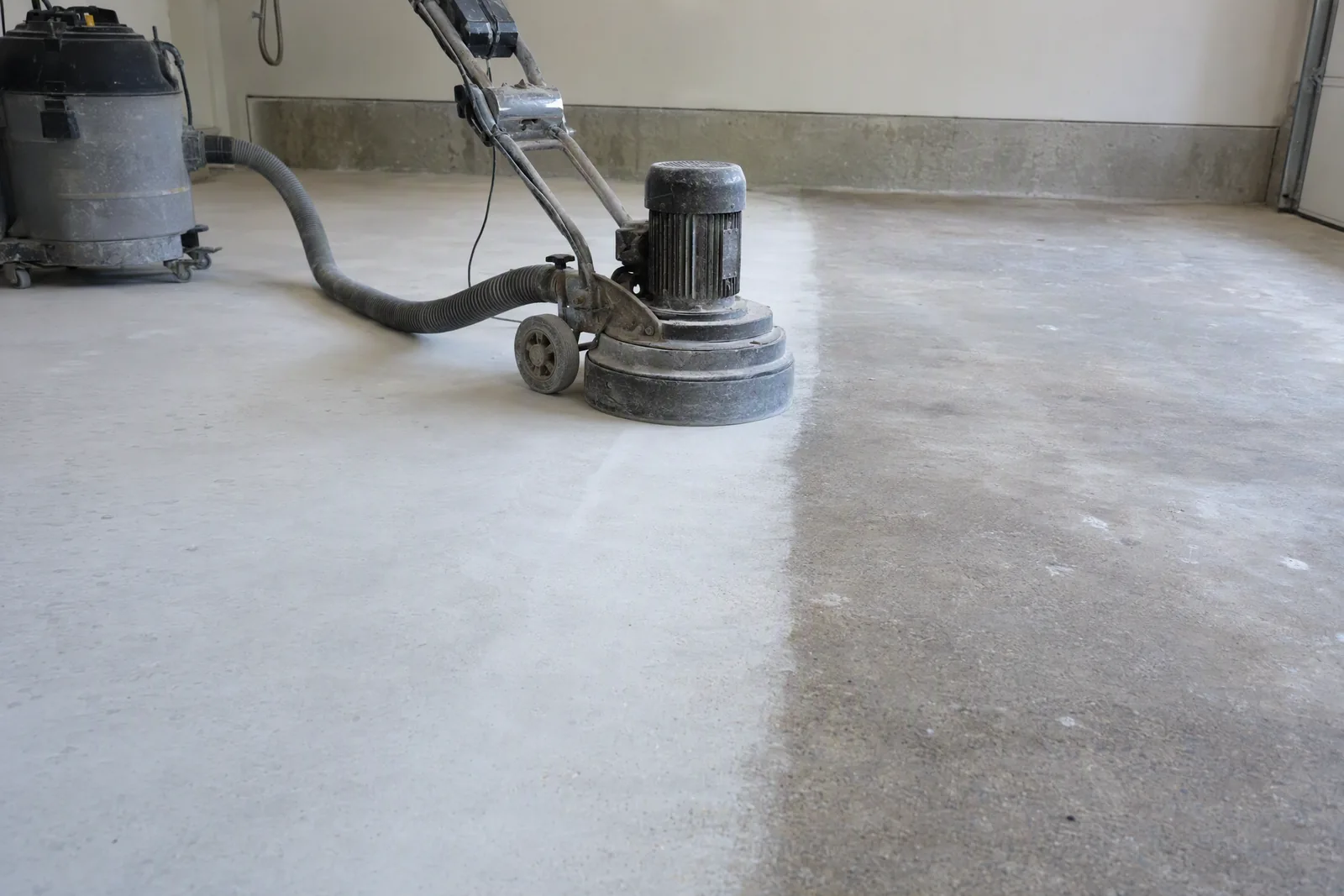
- Grind flush. Once cured, ground level with the surrounding slab so there's no ridge under the coating.
Control joints
Saw-cut control joints exist to give the slab a planned place to crack. There are two approaches: fill and coat over them for a seamless look, or honour them through the coating with a flexible sealant. Filling looks better and is what most homeowners want; honouring is safer on a slab with any history of movement. We'll recommend based on what we see.
Spalling
Spalling is surface concrete breaking away in flakes or sheets, usually from moisture and salt getting into the top layer and expanding. It's common near garage door thresholds where water runs in. Small areas patch well. Large areas of failed surface sometimes mean the top of the slab is no longer sound, and coating over unsound concrete just relocates the problem.
Reading a crack
You can learn a lot about a crack before anyone touches it, and it is worth knowing what to look for when a contractor tells you it is or is not a problem.
| What you see | Likely meaning |
|---|---|
| Thin, meandering, roughly uniform width | Shrinkage crack from the original cure. Dormant. Routine repair |
| Straight, following a saw line | The control joint doing its job. Not a defect |
| Wider at one end, tapering | Differential settlement. Investigate before coating |
| One side higher than the other | Vertical displacement. Active. Structural question |
| Radiating from a corner | Re-entrant corner cracking. Usually dormant but check |
| Map-like network across a wide area | Crazing or alkali-silica reaction. Needs assessment |
Why routing matters
A hairline crack is perhaps 0.5mm wide at the surface. Filling material cannot penetrate that, so anything applied simply sits on top and is ground off on the next pass, leaving the crack exactly as it was.
Routing opens the crack into a channel with enough width and depth to hold material and enough surface area for it to bond. We use a crack chaser wheel to cut a clean V or U section, typically 6mm wide and as deep. That geometry also means the filler is loaded in compression rather than being a thin skin, so it takes traffic load properly.
Choosing filler material
Semi-rigid polyurea
The default for cracks and joints in traffic areas. Cures fast, takes wheel load without deforming, but retains enough flexibility to absorb minor movement. Grinds flush cleanly.
Epoxy mortar
For spalls and larger voids. Very strong, bonds excellently, but rigid — wrong choice anywhere that moves.
Cementitious patch
Cheaper, used for large area repairs. Needs cure time before coating and can have different absorption than the surrounding slab.
Flexible sealant
Only where a joint is being honoured rather than filled. Stays soft permanently and cannot be coated over.
The threshold spall
The most common repair we do in Reno is a spalled garage door threshold. Water runs in under a worn door seal, sits at the low point, and over years works into the surface. Freeze is not the mechanism here as it is in colder markets — it is dissolved salts and simple saturation cycling.
The repair is straightforward: saw-cut a clean edge around the failed area, remove to sound concrete, prime and fill with epoxy mortar, grind flush. What matters more is fixing the cause. Replace the door seal, and check that the apron outside slopes away rather than toward the opening.
What we cannot fix
Being clear about this matters more than being reassuring. We do not do structural work. If your slab has settled, heaved, or has cracks with vertical displacement, the movement has a cause — subgrade, drainage, plumbing leak, root intrusion — and coating over it achieves nothing except hiding the evidence for a while.
In those cases we will tell you what we see, suggest you get a foundation or geotechnical opinion, and leave the quote open. Several customers a year come back six months later having sorted the underlying issue, and then we do a floor that lasts.
Common questions
Will I be able to see where the repairs were?
Under a full-broadcast flake floor, no — the chip pattern breaks up the surface completely and repairs disappear.
Under a solid colour or metallic finish, possibly. Those show substrate variation, and a large patch can read as a slightly different texture even when it's perfectly flush. It's one of the practical reasons we steer damaged slabs toward flake.
My garage has one long crack. Is that a problem?
Usually not. A single straight crack running across a garage slab is most often a shrinkage crack from the original cure, and it's dormant. Routed, filled and ground flush, it disappears.
What would concern us is a crack with vertical displacement — one side sitting higher than the other — or one that's visibly wider at one end. Those suggest movement.
Ready for a floor that survives a Sierra winter?
Free on-site measure, honest assessment of your slab, and a written quote you can hold us to.