Grouped roughly by what people ask first. For deeper detail on any of these, the linked guides go further.
Quick reference
| Question | Short answer |
|---|---|
| Cost, standard 2-car | $2,400–$4,200 installed |
| Install time | One day for most garages |
| Walk on it | 4–8 hours |
| Park on it | 24–72 hours |
| Full cure | About 7 days |
| Realistic life | 15–20 years before a topcoat refresh |
| Prep method | Diamond grinding, never acid etch |
| Topcoat | Aliphatic polyaspartic |
| Lead time to book | 1–3 weeks |
| Deposit | Modest; balance on completion |
Common questions
How much does a garage floor coating cost in Reno?
A standard two-car garage typically runs $2,400 to $4,200 installed. Three-car garages run roughly $3,600 to $6,500. Per-square-foot cost drops as the area increases.
The biggest variable is slab condition. Removing a failed coating adds 30 to 60 percent, and extensive crack or spall repair adds more. Our cost guide breaks all of this down.
How long does the installation take?
Many standard two-car garages are finished within a single working day: grinding and prep in the morning, base coat and flake broadcast midday, topcoat in the afternoon.
Larger floors or slabs needing significant repair run into a second day, usually because repairs have to cure before we can coat over them.
When can I park on it?
Foot traffic the same evening, usually four to eight hours after the topcoat. Vehicles after 24 to 72 hours depending on temperature and the system.
We give you a specific time before we leave. Parking early is the one thing that reliably damages a good floor, and it isn't covered by warranty.
Do you grind or acid etch?
We diamond grind, always, with HEPA dust extraction. We never acid etch.
Etching produces marginal surface profile, leaves residue that must be neutralised and rinsed, and does nothing about existing sealers or oil contamination. Every major manufacturer specifies mechanical preparation.
Why does my slab need a moisture test?
Because the dry air here misleads people. What matters is the vapour gradient between the ground and your slab, and spring snowmelt moves a great deal of water through that ground. Many older Reno garages were poured with no vapour retarder beneath them.
Sealed under a coating, that vapour lifts the film in blisters. We've measured over-limit slabs across this metro more than once.
Will the floor turn yellow?
Not under a polyaspartic topcoat. Under an epoxy topcoat, yes — epoxy ambers under UV, and in a garage that shows as a discoloured band a few feet inside the door where sunlight reaches.
It's the single strongest argument against finishing a Reno garage in straight epoxy.
Why does road brine damage a garage floor?
Chloride from magnesium chloride brine attacks bare concrete directly, and it exploits any weak bond in a coating. Wherever an edge was not properly ground or a threshold was terminated thin, brine works underneath and lifts the film from below.
A sound polyaspartic system handles chloride exposure fine. What it cannot survive is a bad edge.
Can you coat over my existing floor?
Only if it's well bonded everywhere. We score and pull-test in several places at the quote.
If any of it lifts under light pressure, all of it has to come off — a new coating is only as good as what it's stuck to.
How long will it last?
A properly prepped flake system with a polyaspartic topcoat should give 15 to 20 years in a residential garage before it wants a recoat, and that recoat is a topcoat refresh rather than a teardown.
A badly prepped floor can fail in a single summer. Prep is the variable, not the product.
Is it slippery?
A full-broadcast flake floor has real texture from the chips and is less slippery wet than sealed concrete. For more grip we add polymer grit to the topcoat or use a quartz broadcast system.
Smooth metallic and solid floors are the slipperiest when wet, which is worth knowing if you're choosing on looks alone.
Do I need to empty the garage?
Yes, completely, including shelving where possible. We need access to every inch of slab.
Most people move things to the driveway for the day. If you have built-in cabinets that can't move, tell us at the quote so we can plan the cut-in.
What about the smell?
Modern systems are low-VOC and much less pungent than solvent-based products of twenty years ago, but there is an odour during application and for a few hours after. We ventilate throughout.
Tell us when you book if anyone in the house is pregnant, asthmatic or chemically sensitive.
Can you match a colour I've seen?
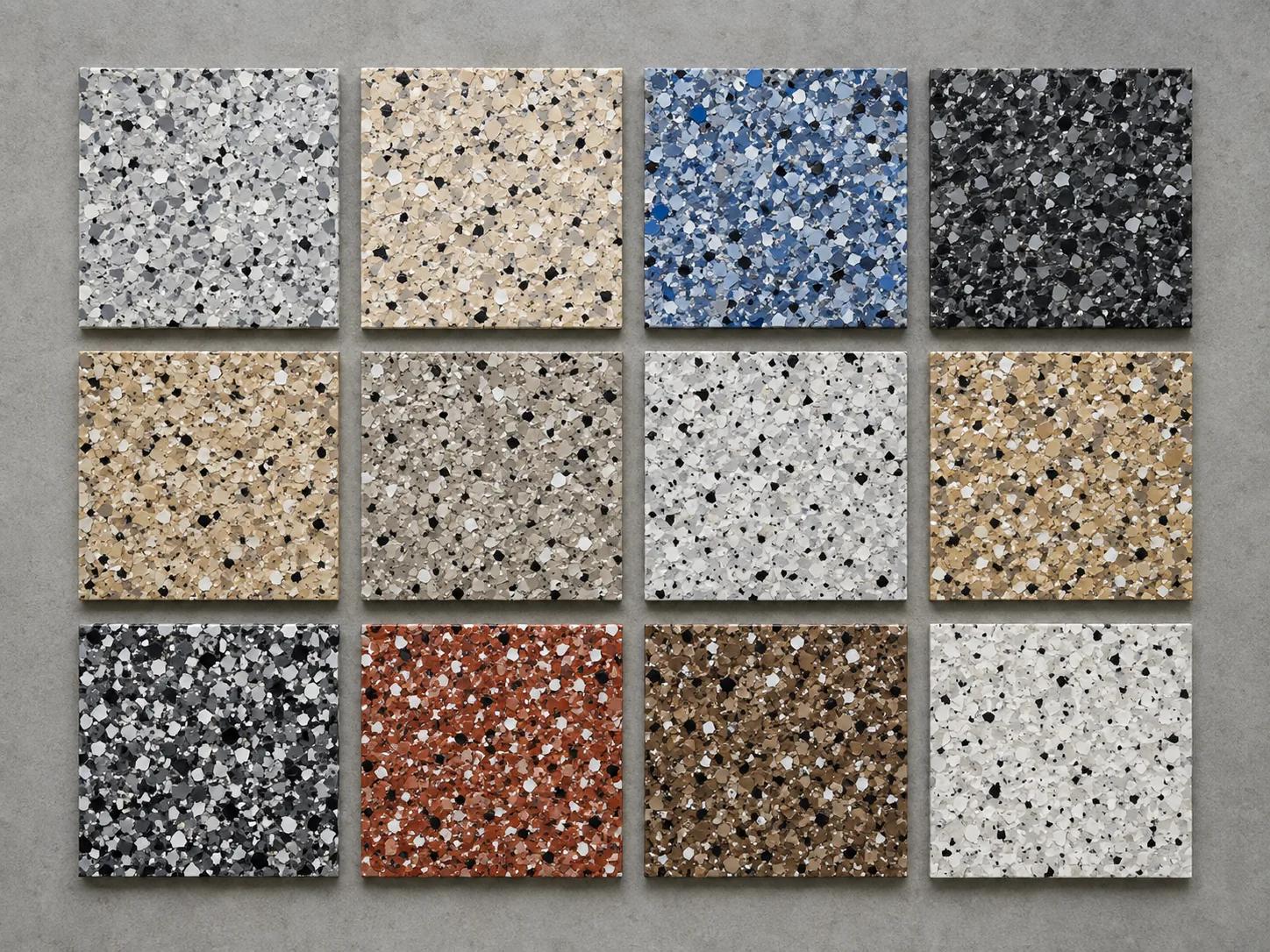
Usually. Flake blends are made from standard chip colours, so most combinations can be matched or closely approximated. Bring a photo.
Metallic finishes can't be matched exactly, because the pattern emerges during cure rather than being applied.
Do you do commercial work?
Yes — warehouses, service bays, showrooms, kitchens, hangars and light manufacturing. We work nights and weekends where a space can't close during business hours, and we phase large floors so you keep partial use.
What does the warranty cover?
Delamination and adhesion failure under normal use, hot tire pickup on a correctly cured floor, and workmanship defects.
It excludes impact damage, damage from parking before the stated cure time, rubber mat staining, new structural movement, and moisture failure where testing was declined. Full detail on the care and warranty page.
Can I do this myself?
You can get a decent result if you rent a proper walk-behind grinder with extraction, buy a two-part 100% solids product from a coatings supplier rather than a big-box kit, and budget real time for hand-grinding edges.
What doesn't work is the kit-and-acid-etch route. That's most of the failed floors we remove.
What if my slab has cracks?
Dormant cracks — the usual shrinkage cracking from the original cure — get routed, filled with semi-rigid polyurea and ground flush. Under a flake floor they disappear entirely.
Active cracks still moving from settlement are different. Coating over movement just means the crack reappears through the finish.
Do you work on new construction?
Yes, but we confirm the pour date first. Concrete needs roughly 28 days before it can take a coating, and in fast-moving new-build neighbourhoods that window gets squeezed.
If nobody can tell us the date, we test the slab rather than guess.
How do I get a quote?
Call 775-362-7367 or use the form on any page. We call back to understand the space, then come out for a free on-site measure, usually within a few days.
You get a written quote with the system specified line by line — prep method, broadcast coverage, topcoat product — not a single number with nothing behind it.
Do you take a deposit?
A modest one to hold the schedule, with the balance due on completion.
Be cautious of any contractor asking for most of the money up front. It's not the norm in this trade and it removes your leverage if something goes wrong.
Ready for a floor that survives a Sierra winter?
Free on-site measure, honest assessment of your slab, and a written quote you can hold us to.