Polishing runs the slab through progressively finer diamond grits, with a chemical densifier applied partway through that reacts with free lime in the concrete to harden the surface from within. The result is a floor whose wear surface is the concrete itself.
The honest tradeoff
The advantage is permanence: no delamination, no hot tire pickup, no UV ambering, because there is no film. The disadvantage is that you get the slab you have. Polishing reveals aggregate, colour variation, old stains and repairs rather than hiding them. Some people want exactly that. Others are surprised by it.
| Polished concrete | Flake coating | |
|---|---|---|
| Can it peel? | No | Yes, if prepped badly |
| Hides slab defects | No | Yes |
| Stain resistance | Moderate; needs sealing | High |
| Colour choice | Limited to dye and existing concrete | Wide |
| Slip resistance | Lower when wet | Higher |
Grit levels and gloss
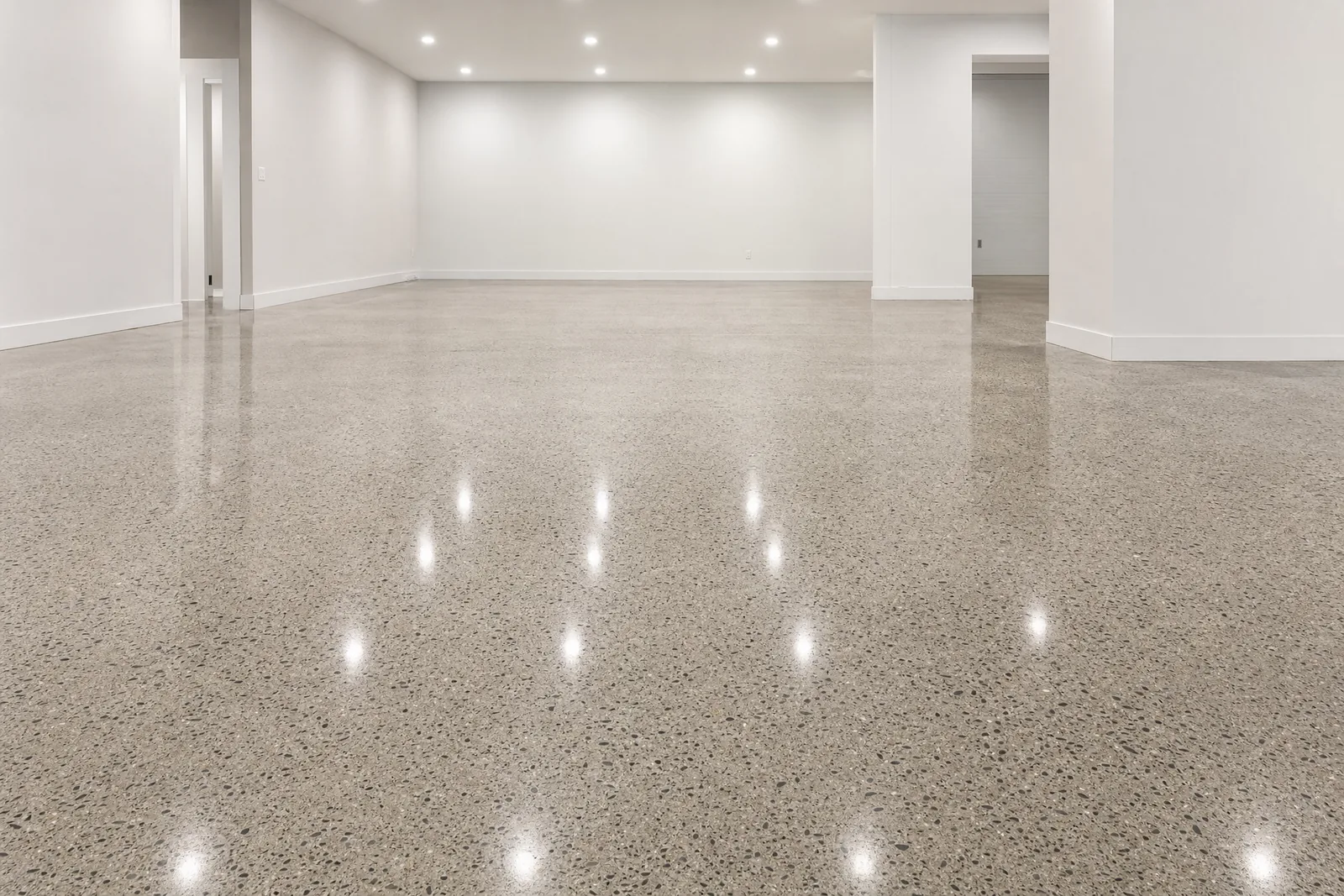
Polishing is a sequence, and where you stop determines the finish. Each pass uses progressively finer diamonds, and the industry describes the result by the final grit and the measured gloss.
| Final grit | Appearance | Typical use |
|---|---|---|
| 100–200 | Flat, matte, ground rather than polished | Warehouses, back of house |
| 400 | Satin sheen, low reflection | Garages, workshops |
| 800 | Semi-gloss, clear reflection | Retail, residential interiors |
| 1500–3000 | High gloss, mirror-like | Showrooms, feature spaces |
Higher grit costs more because each pass is a full pass over the whole floor. Going from 400 to 1500 roughly doubles the labour. It also shows more — a mirror finish reveals every undulation in the original pour.
Aggregate exposure
How deep you grind determines what you see. This is decided at the first pass and cannot be undone.
- Cream finish. Minimal removal; you see the cement paste surface with almost no aggregate. Cleanest and most uniform look.
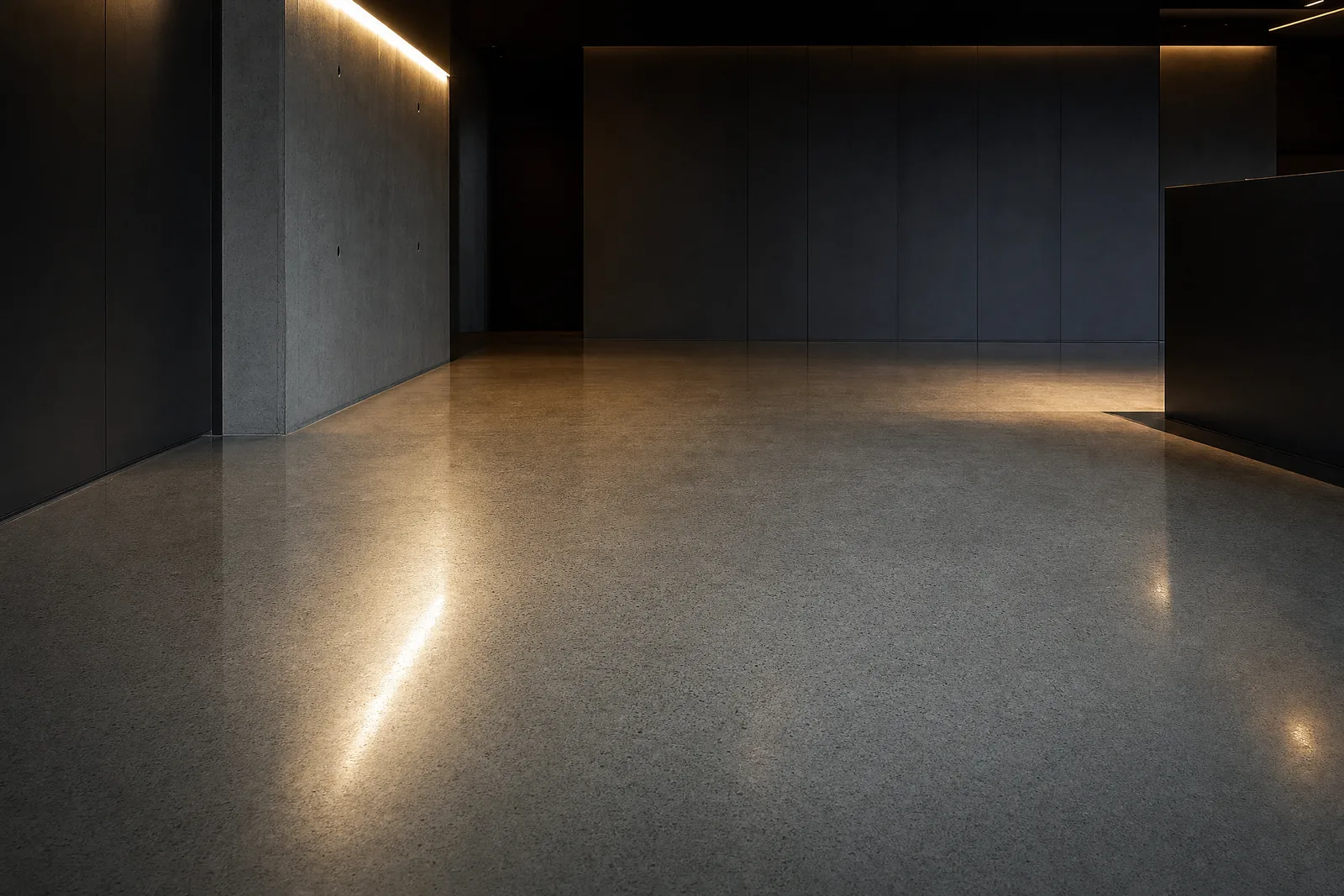
- Salt and pepper. Removing a few millimetres exposes the fine sand aggregate. The most popular choice and the most forgiving.
- Full aggregate. Grinding deep enough to expose the large stone. Dramatic and very much a design statement, but it demands a slab with well-distributed aggregate — and you find out whether you have one only after you start.
Densifiers
Partway through the grit sequence, a chemical densifier — usually lithium, sodium or potassium silicate — is applied. It reacts with free calcium hydroxide in the concrete to form additional calcium silicate hydrate, the same compound that gives concrete its strength. The surface becomes measurably harder, less porous, and takes a better polish.
This is not optional in a proper polish, and it is the step most often skipped in a cheap "polished concrete" quote that is really just grinding and sealing. A ground-and-sealed floor looks similar for about a year, then the sealer wears through in traffic paths.
Maintaining a polished floor
Polished concrete needs different maintenance from a coated floor, and getting it wrong is the most common reason a good polish stops looking good.
- Dust mop frequently. Grit is the whole problem. On a polished floor it acts as lapping compound underfoot and dulls the sheen in traffic paths.
- Neutral cleaner only. Anything acidic etches the surface; anything alkaline leaves film. pH-neutral, always.
- No wax or acrylic sealer. People apply these thinking they protect the floor. They build a soft film that scuffs, then has to be stripped — and stripping chemicals attack the densified surface underneath.
- Burnish periodically. A high-speed pass with a fine pad restores sheen without regrinding. Every one to three years depending on traffic.
Where polishing beats coating, honestly
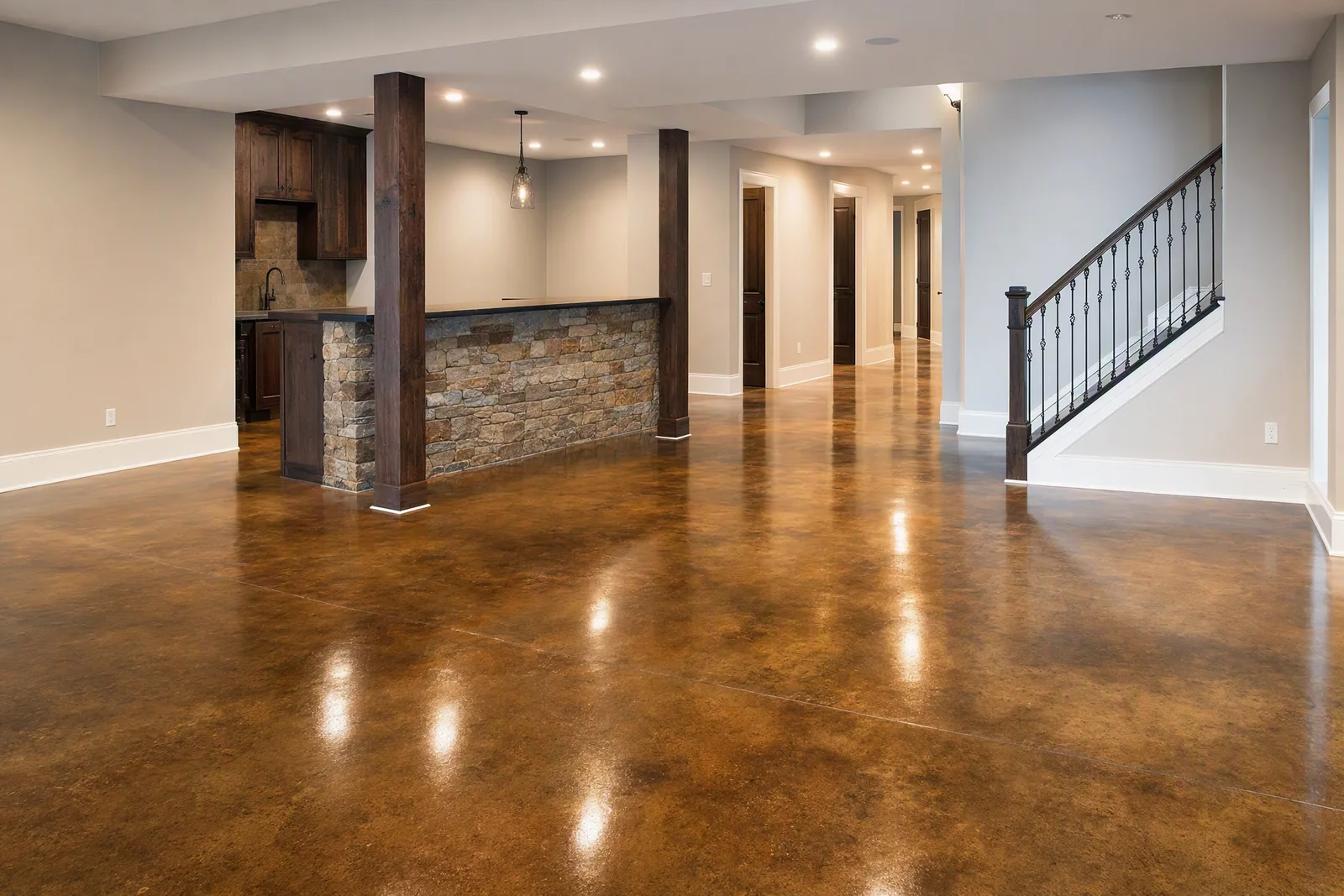
Three situations where we would recommend polish over a coating without hesitation. A space with very high moisture emission, because there is no film to lift. A warehouse with heavy forklift traffic, where the wear surface being the slab itself means there is nothing to chip at joint edges. And any client who genuinely wants a concrete aesthetic rather than a decorative one.
Everywhere else, a coating usually gives more — colour choice, stain resistance, hiding power over a slab that has seen some life. We do both and have no preference between them.
Common questions
Does polished concrete stain?
More easily than a coated floor. It's still concrete, and it's porous until sealed. A penetrating sealer helps considerably, and oil that's wiped up promptly generally won't mark.
Oil left to sit will darken the surface, and that stain is very difficult to remove because it's in the slab rather than on it.
Can any slab be polished?
No, and this is the main limitation. The slab needs adequate hardness, reasonable flatness, and no significant soft or spalled areas. A slab that was finished poorly or has a weak surface layer won't take a polish evenly.
We test a small area before quoting so nobody is guessing.
Ready for a floor that survives a Sierra winter?
Free on-site measure, honest assessment of your slab, and a written quote you can hold us to.