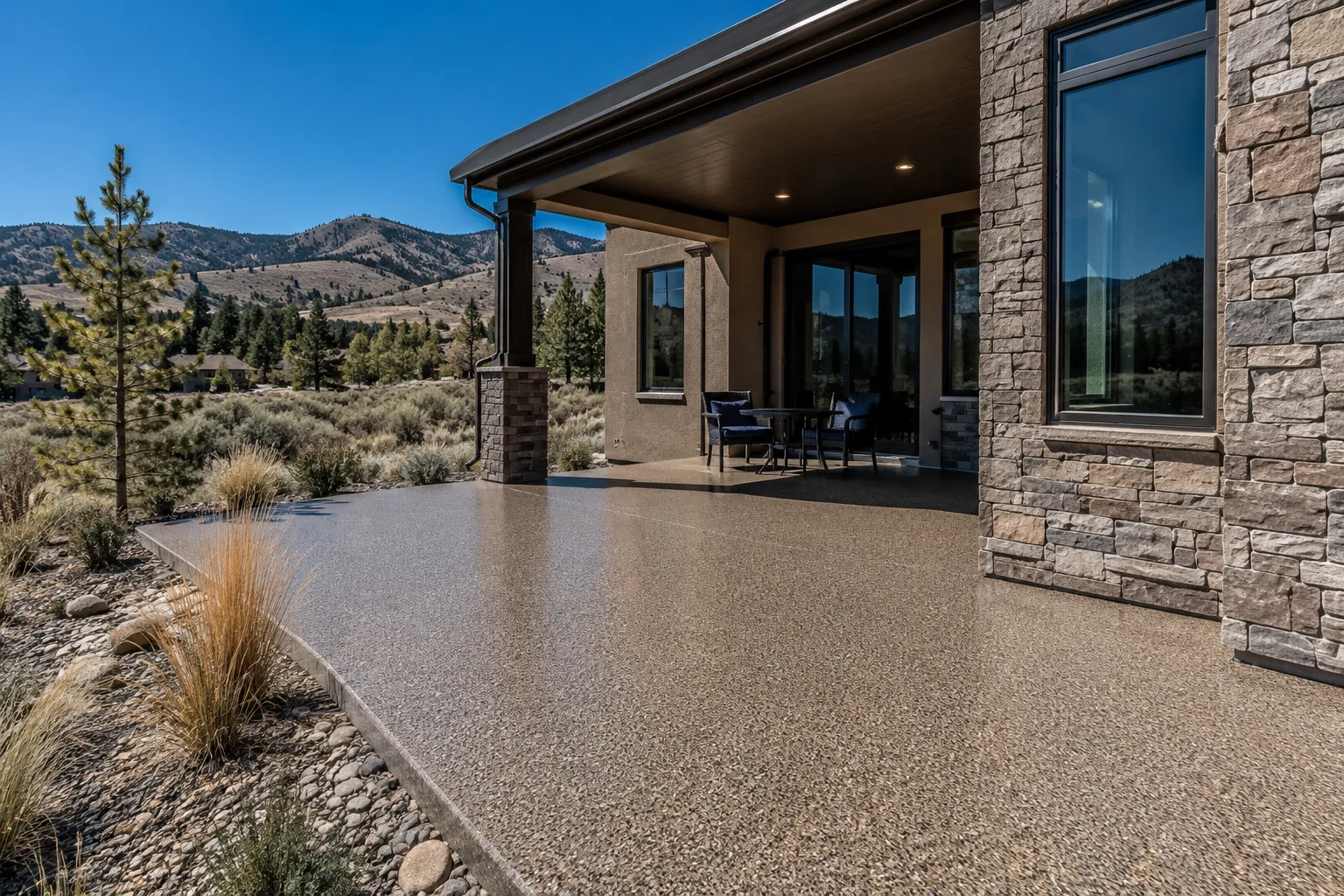
Exterior work is a different specification, not just the same floor moved outside. Three constraints drive everything:
- UV. Epoxy is not a UV-stable topcoat. Outdoors it will chalk and amber within a season. Exterior work gets an aliphatic polyaspartic or polyurethane topcoat.
- Surface temperature. Dark colours on a pool deck in July are genuinely unusable barefoot. Colour choice is a comfort decision here, not an aesthetic one.
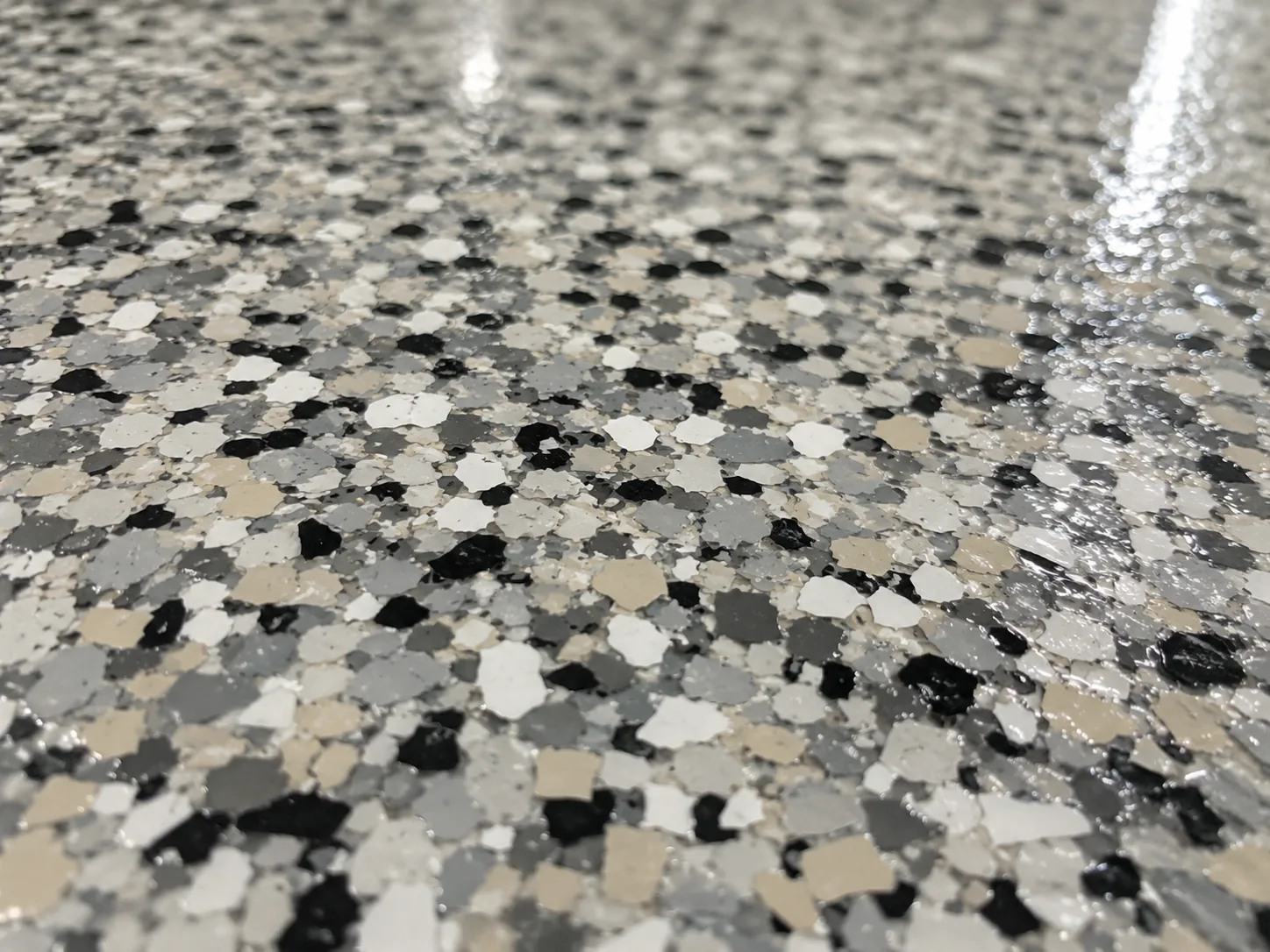
- Slip resistance. Wet feet on a smooth surface next to water is the worst case. Quartz broadcast or an aggressive grit topcoat is standard.
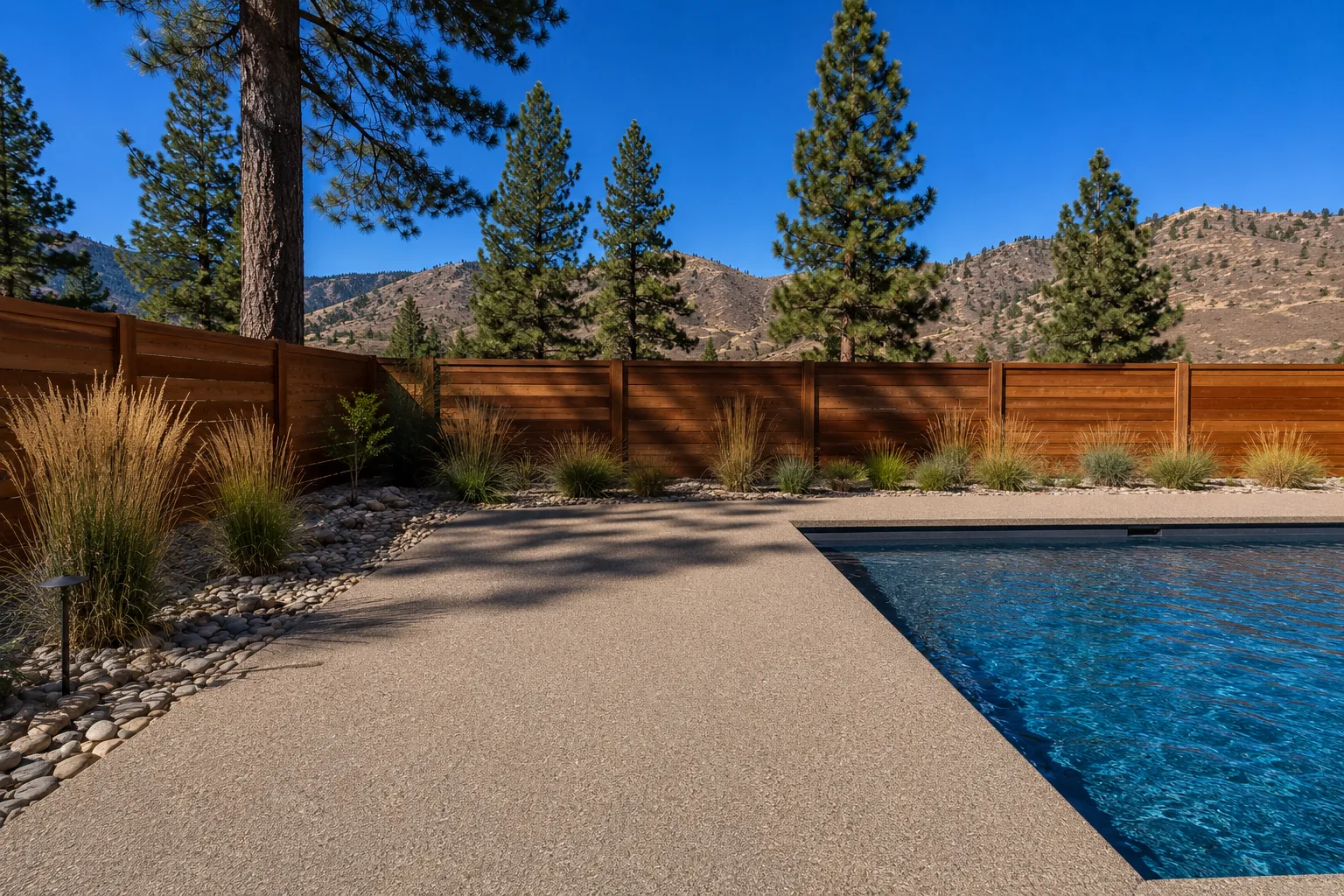
Cool-deck options
Light tans, sand tones and creams in a textured quartz system run meaningfully cooler than a dark smooth surface. There are also topcoats formulated specifically to reduce heat absorption. For a deck that takes full afternoon sun — which is most of them in this valley — we'd spec both.
Existing surfaces
A lot of Reno pool decks are stamped concrete or old Kool Deck that has worn through. Both can usually be resurfaced rather than removed, provided the substrate is sound. Delaminating Kool Deck has to come off first, which is a real cost and worth knowing before you plan.
The freeze-thaw problem outdoors
An exterior slab in Reno is the hardest-worked concrete on your property. It takes the full freeze-thaw cycle with nothing between it and the weather, and unlike a garage floor there is no roof keeping water off it.
Water soaks into the surface, freezes, expands by roughly nine percent, and prises the top layer apart. Do that eighty to a hundred times a winter and an unprotected patio or pool deck starts spalling. A coating helps considerably by keeping water out of the concrete in the first place — but only if it is genuinely sound at every edge and joint, because water that gets underneath and freezes there does more damage than no coating at all.
| Factor | Why it matters on a Nevada exterior slab |
|---|---|
| Freeze-thaw cycles | 80–110 a year; the primary driver of surface failure |
| Drainage | Ponding water is freeze damage waiting to happen |
| Edge and joint detail | Where water gets under the film and freezes |
| Summer surface heat | Real but secondary; light colours still read cooler barefoot |
| UV | Requires an aliphatic topcoat regardless of climate |
Expansion joints outdoors
Exterior slabs move considerably more than interior ones, because they see the full seasonal range — from a slab well below freezing on a January night to one baking under high-altitude sun in August, sometimes crossing freezing twice in the same twenty-four hours.
Expansion joints exist to absorb that movement, and they must be honoured through the coating rather than filled and coated over. A flexible sealant in the joint, with the coating terminating cleanly at each side, is the correct detail. Coating straight across an expansion joint guarantees a crack along that line within a season.
Resurfacing existing decks
Most Reno pool decks are one of three things, and each behaves differently:
- Broom-finish concrete. By far the most common here, and the easiest case. Grind, repair any spalling, coat.
- Stamped concrete. Usually coats well. The texture carries through and a coating is often the most economical way to restore colour that has worn off traffic paths.
- Plain broom-finish concrete. The easiest case. Grind, repair, coat.
Drainage first
Before any exterior coating, water has to go somewhere. A deck that ponds after rain will pond after coating, and standing water sitting on any coating for days at a time is hard on it — particularly at the edges of the puddle where the wet-dry cycle concentrates.
If your deck has a low spot, address it before coating. Sometimes that means a levelling mortar; occasionally it means accepting that a section should be replaced. Either way it is cheaper to know before than after.
Common questions
How does a coated pool deck survive winter?
The coating's job is keeping water out of the concrete, which is exactly what prevents freeze-thaw spalling. A sound coated deck comes through a Nevada winter better than bare concrete does.
What matters is drainage and edge detail. Water that ponds on the surface, or gets under the film at a bad edge and then freezes, does more damage than no coating at all. We spend real time on terminations for that reason.
How does it handle pool chemicals?
An aliphatic topcoat handles chlorinated water, salt systems and normal shock chemistry without issue. Splash-out is routine and the surface is designed for it.
What we'd avoid is letting undiluted chemicals sit on the surface — concentrated shock left in a puddle can mark almost any coating.
Ready for a floor that survives a Sierra winter?
Free on-site measure, honest assessment of your slab, and a written quote you can hold us to.