Home workshops, fabrication shops, storage warehouses and light manufacturing all want something slightly different. The questions we ask are always the same: what gets dropped on it, what gets spilled on it, and what drives across it.
Matching spec to use
| What happens on the floor | What we'd spec |
|---|---|
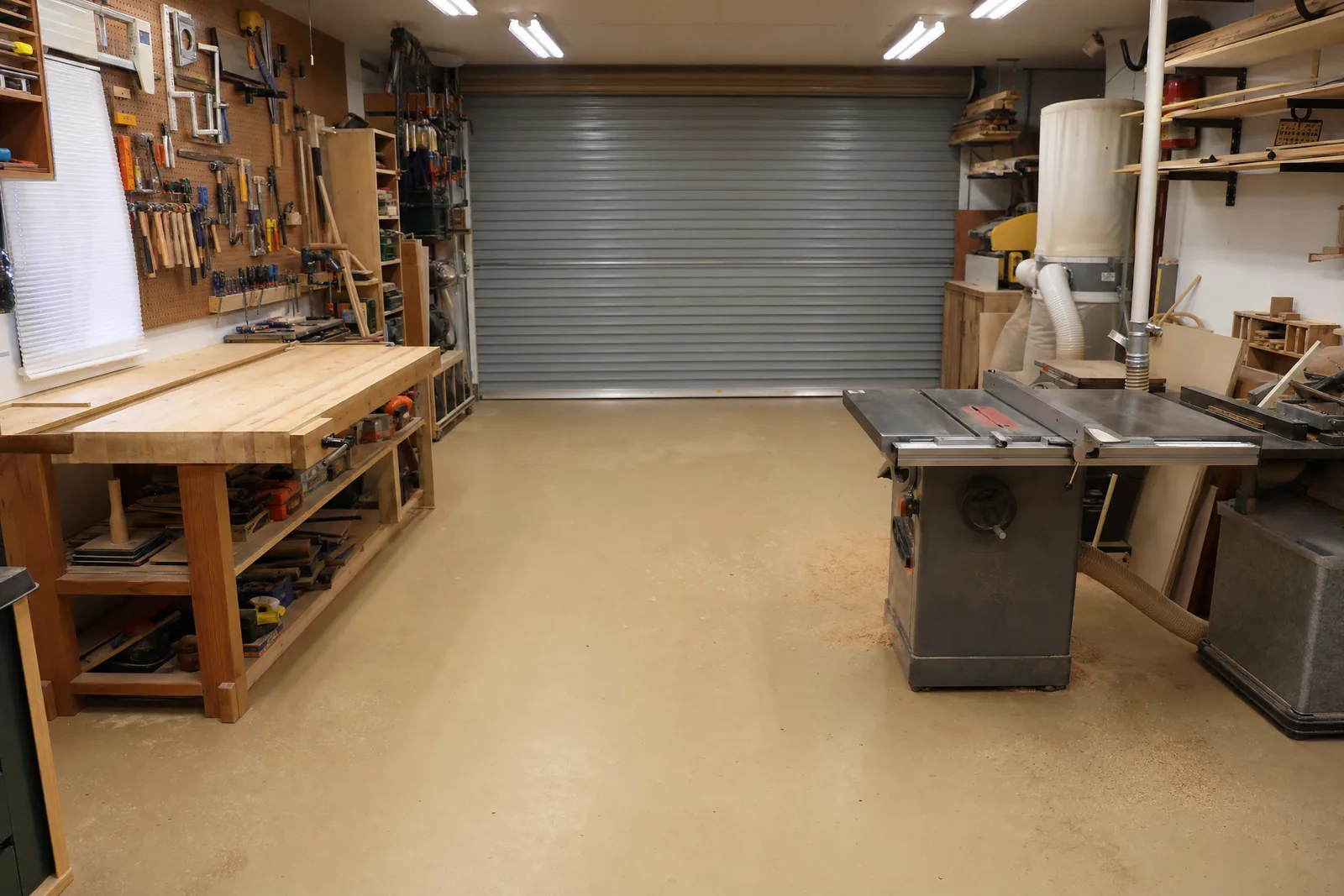
| Woodworking, dust, dropped tools | Flake system, standard topcoat |
| Welding, sparks, hot metal | Solid colour, high-build, sacrificial zones |
| Oil, coolant, brake fluid | Chemical-resistant topcoat, coved base |
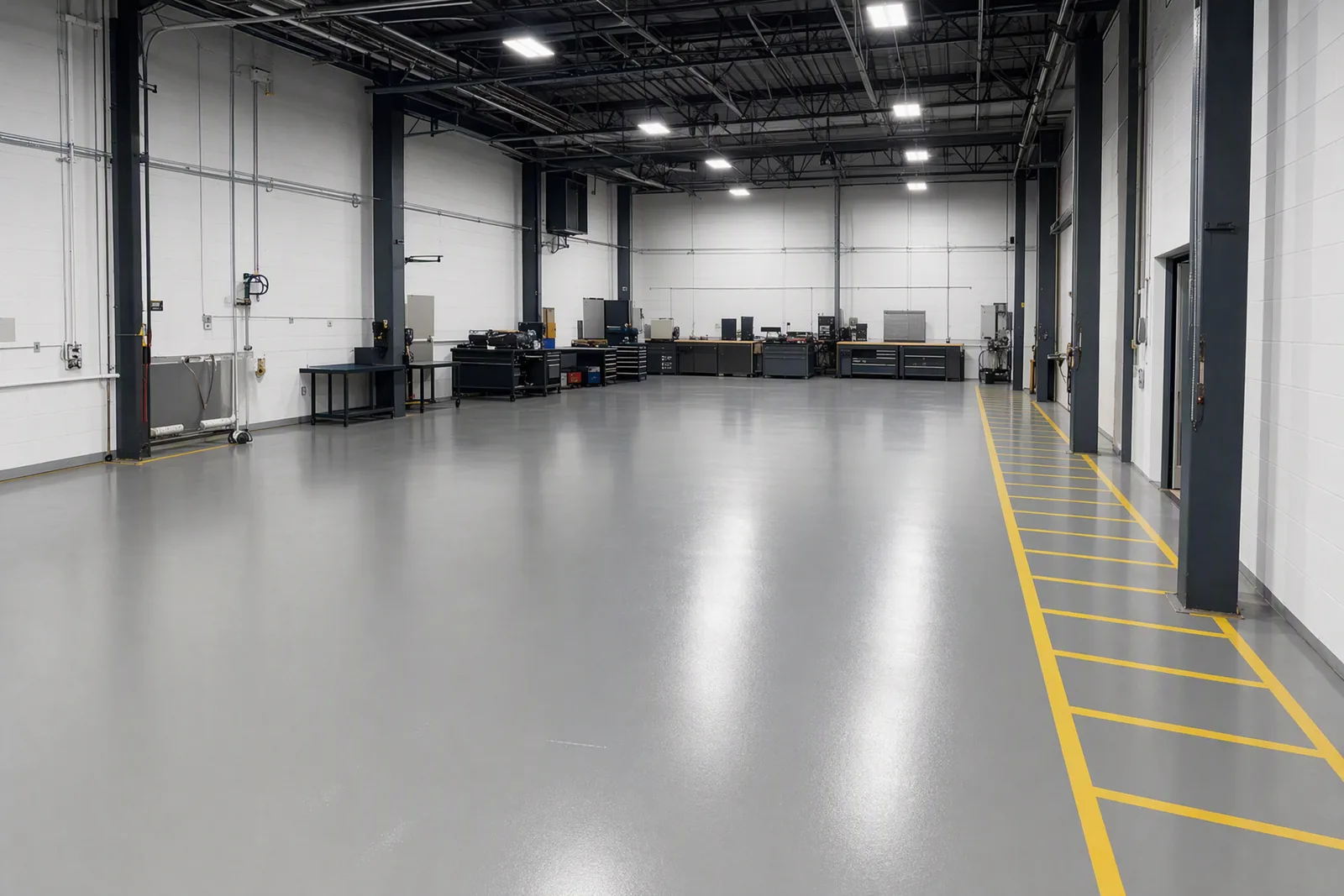
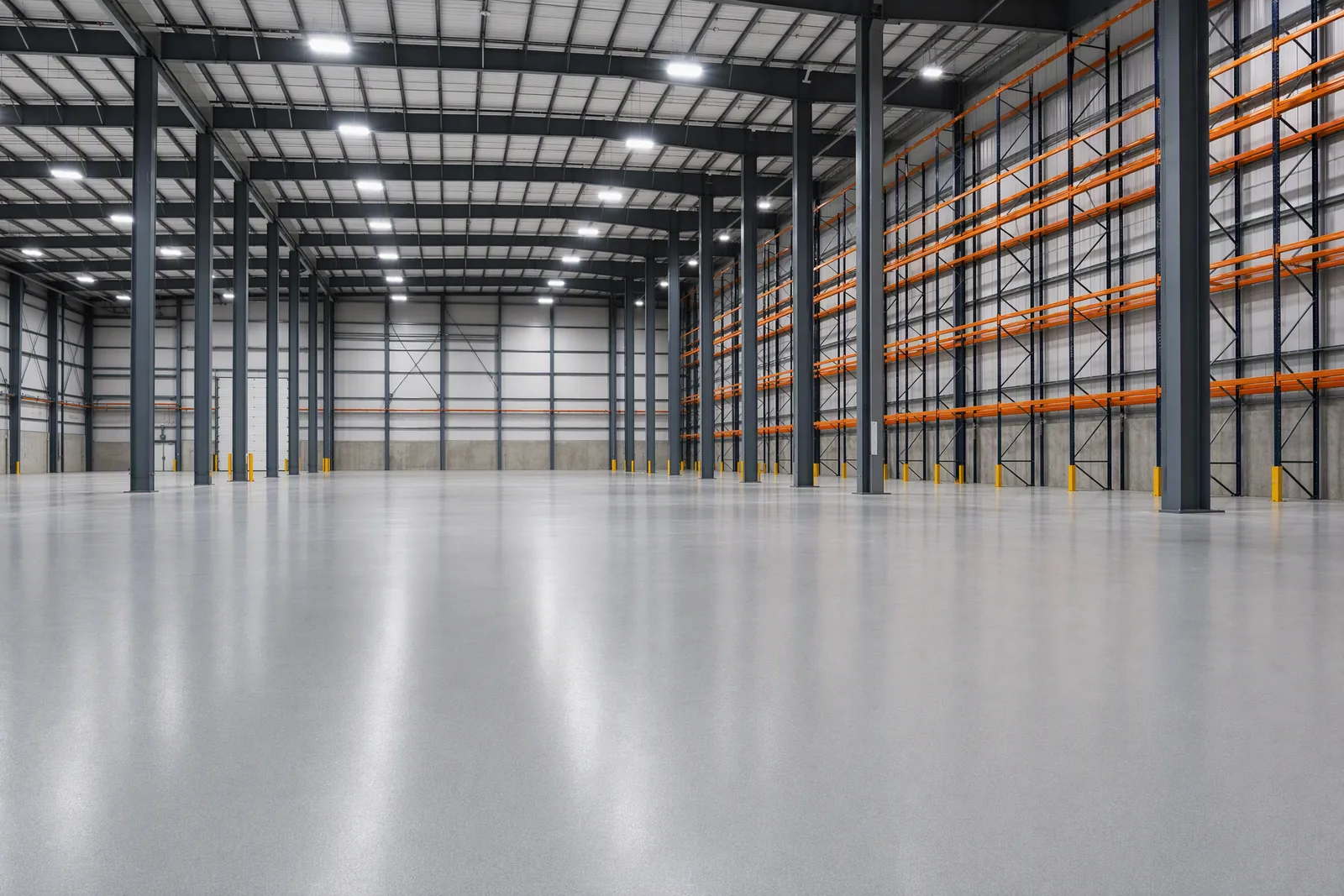
| Forklift and pallet jack traffic | High-build solid, striping, thicker topcoat |
| Wash-down areas | Quartz broadcast, coved base, drainage detail |
A note on impact
No floor coating is impact-proof. A dropped engine block or a steel bar landing corner-first will chip any resin system, the same way it would chip bare concrete. What a good coating does is stop that chip becoming a spall that spreads, and it makes spot repair straightforward.
Zoning a working floor
The most useful thing a coating does in a workshop is not protection — it is organisation. A floor that visually separates function is easier to work in and easier to keep tidy.
Traffic aisles
Marked boundaries keep walkways clear. In commercial settings this is often a requirement rather than a preference.
Equipment footprints
Outlined positions for machines that move. Makes it obvious when something has crept out of place.
Assembly and staging
A different colour field for work-in-progress areas, so staging does not silently expand into the aisle.
Keep-clear zones
Electrical panels, exits, eyewash stations, fire equipment. Hatched marking on the floor is the clearest signal there is.
Dealing with existing oil contamination
An old shop floor is frequently saturated with oil to a depth of several millimetres, and this is the most common reason a workshop coating fails. Resin will not bond to contaminated concrete no matter how well it is ground — the oil migrates back to the surface during cure.
The process is:
- Degrease the surface with an alkaline cleaner and agitate
- Grind, which removes the top layer and exposes contamination depth
- Assess — a water droplet test shows whether the surface still repels
- Poultice the worst areas if needed, drawing oil out chemically
- Re-grind and re-test before any resin goes down
On a badly contaminated floor this can take a full extra day. It is unavoidable, and a quote that does not account for it on an old shop floor is not a real quote.
Static-dissipative options
For electronics work, any space handling flammable vapours, or areas with sensitive equipment, static-dissipative systems are available. They incorporate a conductive layer connected to building ground, holding surface resistance within a specified range. It is a specialist specification with a real cost premium, and it needs testing after install to certify. We can quote it, but tell us at the start — it changes the entire build, not just the topcoat.
Home shop realities
For a home workshop the calculus is different from commercial. You are not meeting a standard, you are trying to make a space pleasant to work in. In that case the priorities are usually: a mid-tone flake floor that hides dust and dropped debris, enough texture to be safe with sawdust underfoot, and a colour light enough to help you find the small part you just dropped. That last one sounds trivial and is mentioned to us more than almost anything else.
Common questions
Will welding spatter damage the floor?
It can mark it, yes. Hot spatter landing on any resin coating will leave a small burn.
The usual approach is a welding blanket or a sacrificial mat in the weld zone rather than trying to spec a coating that survives it. In a dedicated fabrication shop we sometimes leave the weld bay bare and coat everywhere else.
Can I do this myself in a home shop?
You can, and the results are usually disappointing for one specific reason: rental grinders aren't adequate for real profiling, and without profile nothing else you do matters.
We cover this honestly on the DIY page — there are cases where a kit makes sense, and cases where it's money spent twice.
Ready for a floor that survives a Sierra winter?
Free on-site measure, honest assessment of your slab, and a written quote you can hold us to.