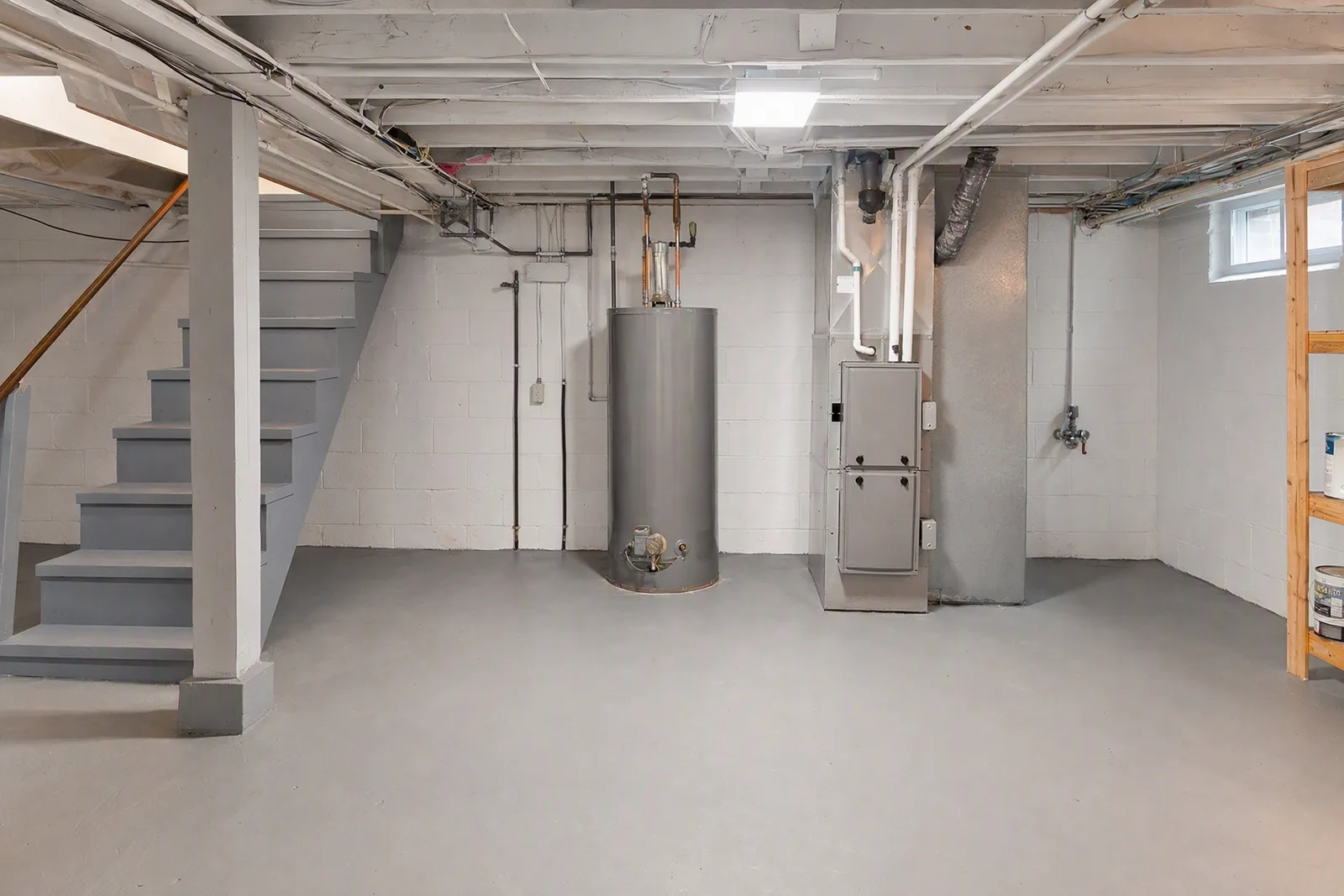
A below-grade slab sits in contact with soil on all sides. With spring snowmelt moving through the ground, that means a moisture profile completely unlike a garage slab poured on grade. Vapour moves upward through concrete continuously, and if it can't escape through the surface it will push a coating off from underneath.
We do not quote a basement floor without testing it first. A calcium chloride or relative humidity test tells us the actual vapour emission rate. That number determines whether you need a moisture-mitigating primer, and skipping it is the most common reason basement coatings blister. See moisture testing.
What we recommend down there
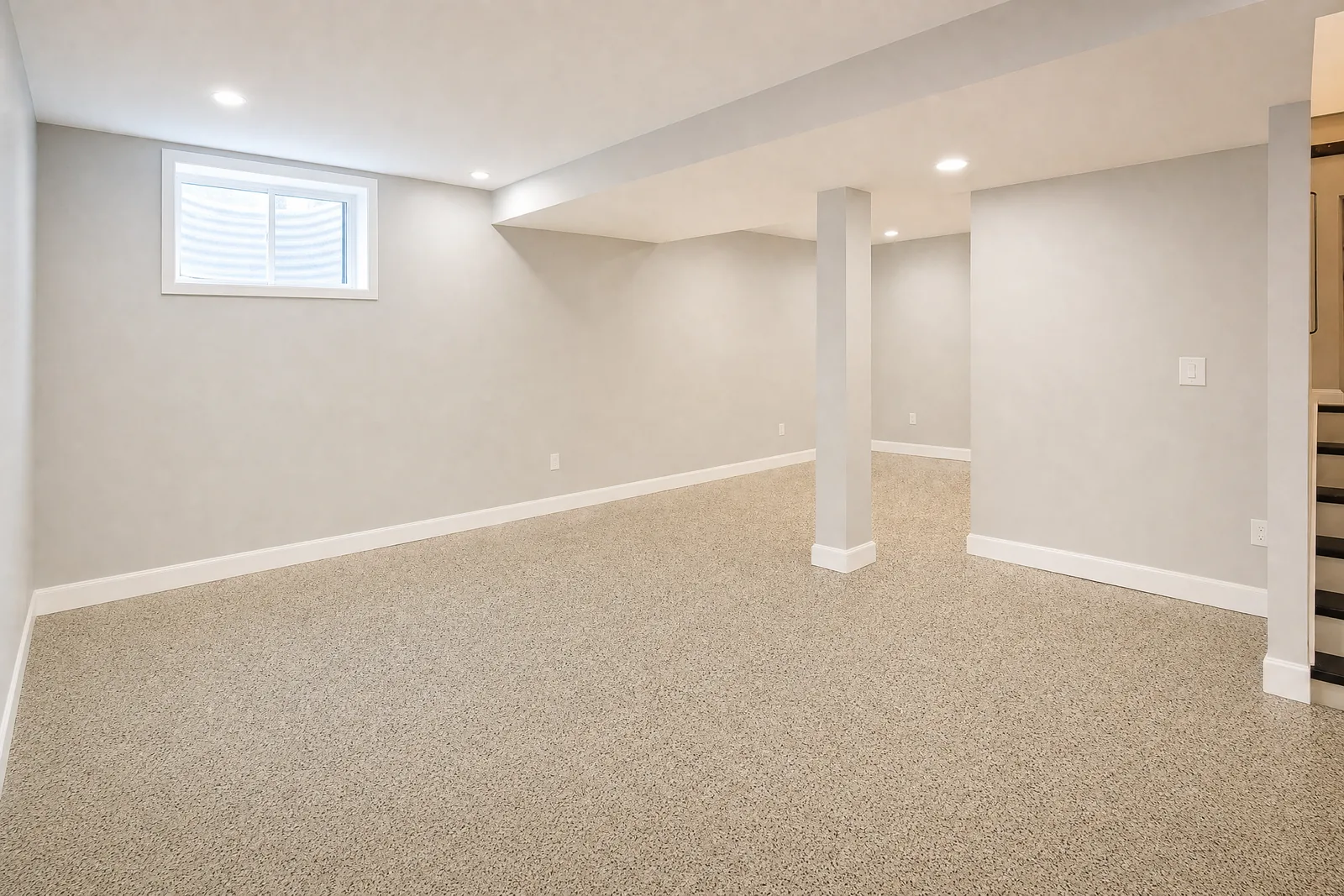
- Flake systems for finished basements — forgiving of slab defects, warmer underfoot than bare concrete, and easy to clean.
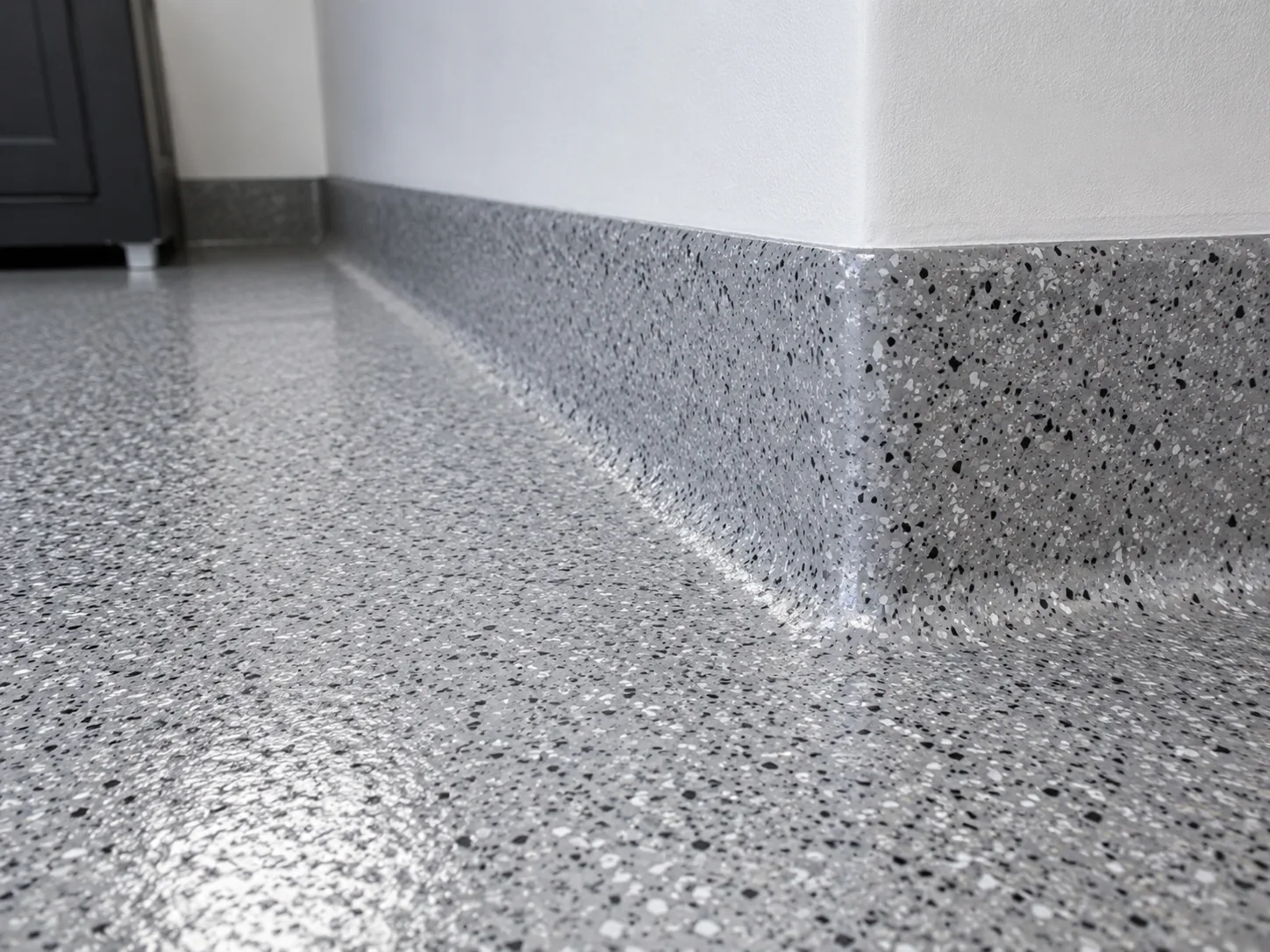
- Coved base where the floor meets the wall. Removes the seam entirely, which matters if the space ever takes water.
- Vapour-barrier primer wherever testing calls for it.
- Lighter colours because basements have no natural light and the floor is the biggest reflective surface you have.
Home gyms
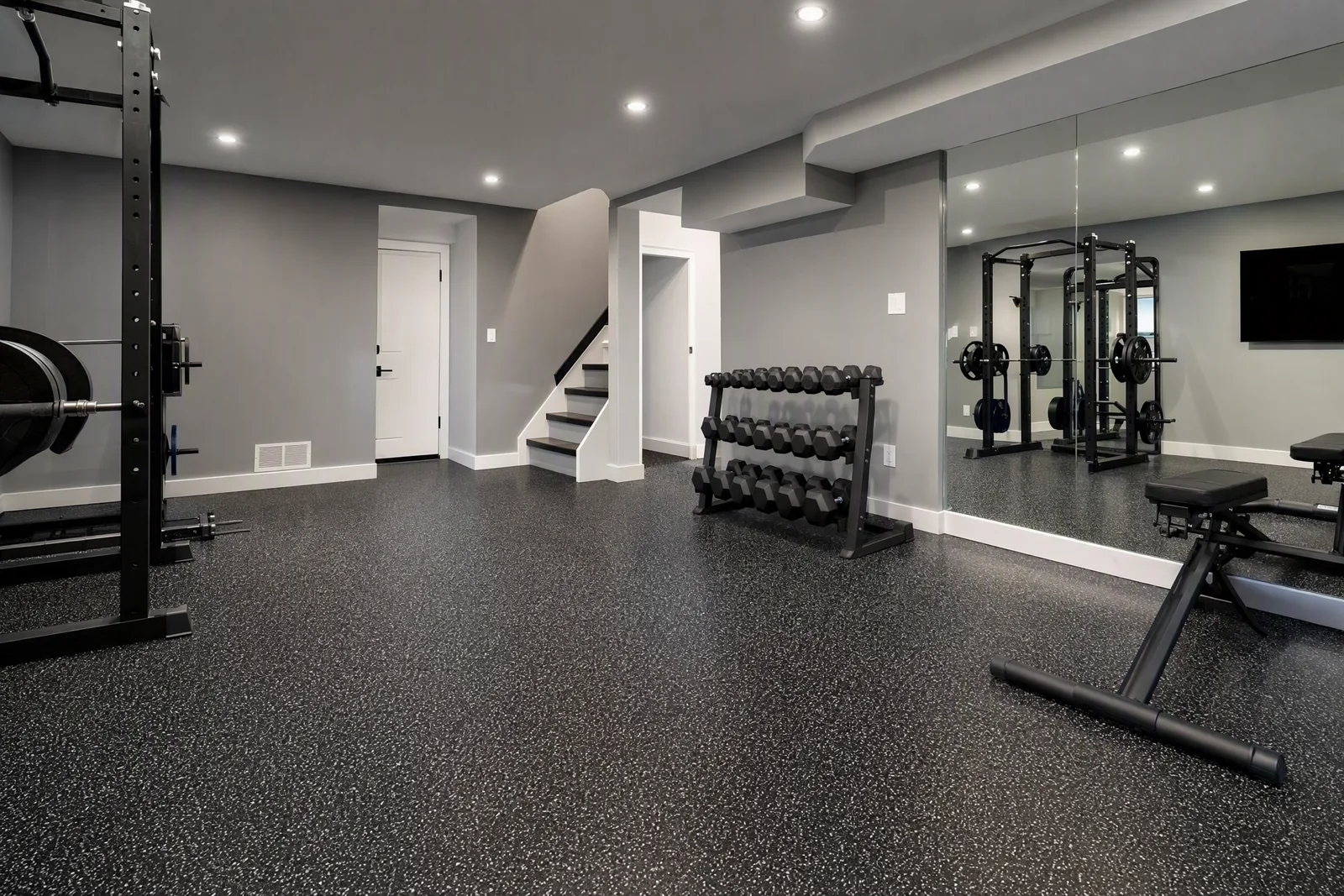
A common conversion. A flake system takes dropped weights better than bare concrete and far better than vinyl plank, and it cleans easily. For serious lifting we'd still put rubber under a platform — no coating is a substitute for that — but everywhere else it holds up well.
Understanding vapour drive
Concrete does not stop water vapour; it slows it. Moisture in the soil around and beneath a below-grade slab moves continuously toward the drier side, which is your basement. An uncoated slab lets that vapour pass through and evaporate, which is why bare basement floors often feel cool and slightly damp but rarely blister.
Seal the top with a coating and the vapour reaches an impermeable film. Pressure builds at the interface. Eventually it exceeds the bond strength of the coating and lifts it, either as small round blisters or as sheet delamination.
The critical point is that this has nothing to do with visible water. A basement floor that has never had a drop of standing water on it can still have a vapour emission rate well beyond what a standard coating tolerates.
Mitigation options by test result
| RH reading | Approach |
|---|---|
| Under 75% | Standard system, no mitigation needed |
| 75–85% | Moisture-tolerant primer; most products accept this range |
| 85–95% | Dedicated vapour-barrier epoxy primer, applied at specified thickness |
| Over 95% | Source must be addressed first — drainage, grading, waterproofing |
The mitigating primer typically adds $1.50 to $3.00 per square foot. On a 900 square foot basement that is $1,350 to $2,700, which is a significant line item and exactly why nobody should be guessing at it.
Radon and sealed floors
Worth mentioning because it comes up: a floor coating is not a radon mitigation system. It will reduce soil gas entry through the slab surface somewhat, but radon predominantly enters through cracks, the slab-wall joint, and sump openings. If you have a radon concern, test for it separately and address it with proper sub-slab depressurisation. Do not treat a coating as a solution.
Finished basement considerations
If the basement is or will be living space, a few things change. Cove the base rather than terminating flat, so cleaning is easier and there is no seam. Choose a lighter blend, because there is no natural light and the floor is the largest reflective surface available. And plan the install before any other finishing work — grinding a floor in a room with finished drywall and trim is a masking nightmare and the results are worse.
Common questions
My basement floor is always slightly damp. Can it be coated?
Possibly, but that's a question to answer with a test rather than a guess. Visible dampness usually means a high vapour emission rate, and a standard coating over it will blister.
There are moisture-mitigating primers rated for high emission slabs. If your numbers exceed what those can handle, we'll tell you the floor isn't a candidate until the source is dealt with — that's a drainage or waterproofing job, not a coatings one.
Will it be cold underfoot?
Warmer than bare concrete, though not by a huge margin — a coating is thin and conducts. If warmth is a priority, the usual answer is an insulated subfloor, which is a different project entirely.
What a coating does reliably is stop the dusting and the damp smell that comes off an unsealed basement slab.
Ready for a floor that survives a Sierra winter?
Free on-site measure, honest assessment of your slab, and a written quote you can hold us to.