Spanish Springs sits north and east of the Truckee Meadows, with a housing mix that leans newer than older Reno stock — a lot of 2010s-to-present subdivisions alongside established streets closer to Pyramid Highway. That mix matters for garage floor coating more than most homeowners expect. A recent pour can look perfect and still need moisture testing. An older slab can look rough and still take a full-broadcast flake system once the threshold and spalls are cut back. The address tells you which neighbourhood you are in; the slab tells you what the floor will cost and how long it will last.
This page covers Spanish Springs specifics: drainage, Sierra brine, unheated garages, diamond grind versus acid etch, and how a free visit becomes a written quote. For the metro process, see epoxy garage floor coating and polyaspartic and polyurea coatings. Nearby: Sparks, South Reno, Somersett, and all service areas.
What we install in Spanish Springs
The systems themselves do not change by zip code. Full-broadcast flake, metallic, quartz anti-slip, and solid colour all go over a diamond-ground slab with a UV-stable polyaspartic topcoat in most residential garages. What changes in Spanish Springs is slab age, moisture behaviour at the door, and how much winter slurry the apron feeds into the opening. That is where prep hours and product film build live — and where honest quotes diverge from square-footage guesses. Real ranges are in the garage floor coating cost guide.
Full-broadcast flake
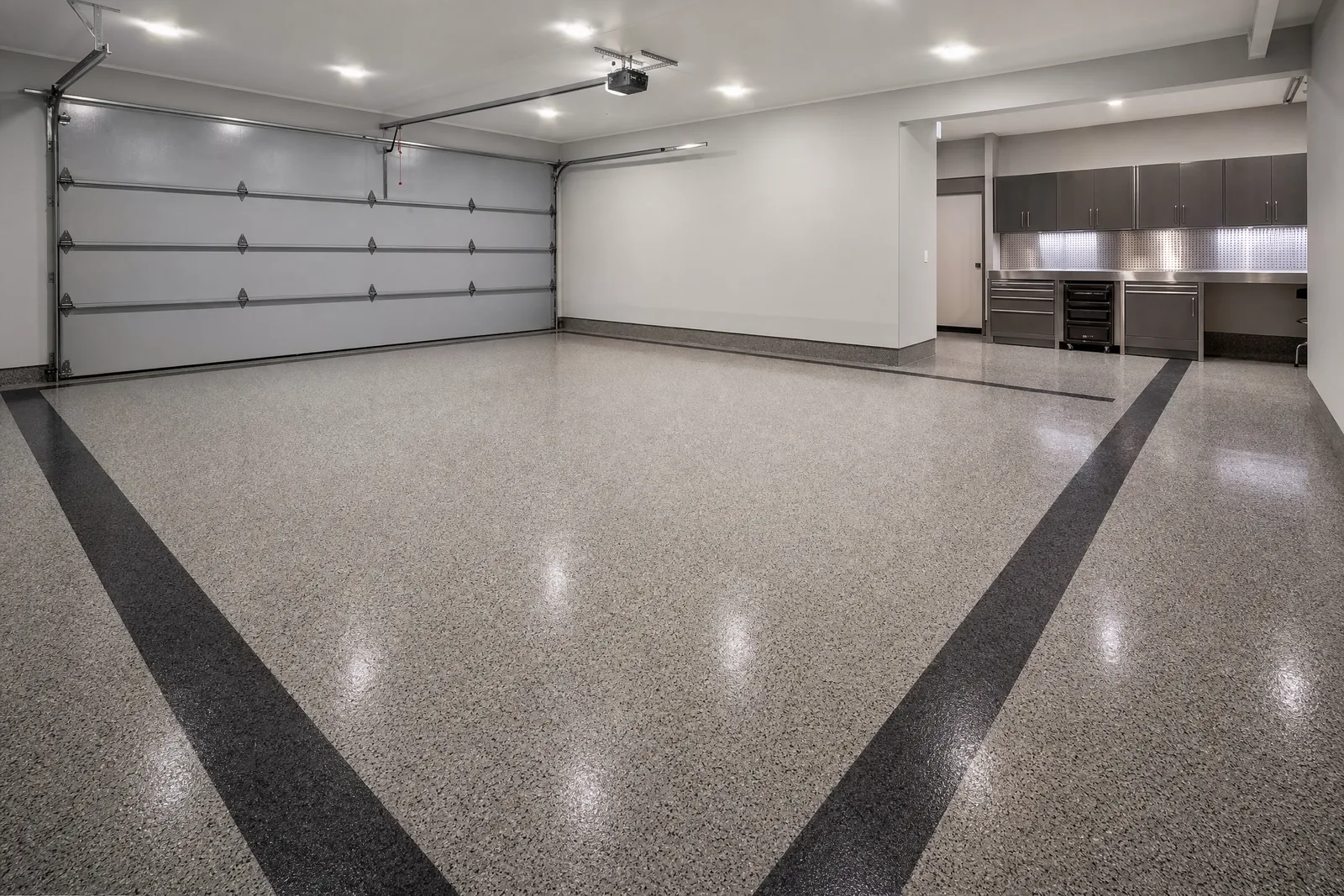
The workhorse for Spanish Springs two- and three-car garages. Hides hairline cracks, softens tire marks, and pairs well with a polyaspartic clear that handles hot tires after a proper cure window.
Polyaspartic topcoats
Chosen because they cure in cold, unheated garages and stay UV-stable under a south-facing door. Thin big-box epoxy alone is a poor match for brine and freeze-thaw here.
Newer housing stock and pour dates
Much of Spanish Springs grew hard from the 2010s onward. Newer slabs are usually flatter and less spalled than mid-century Reno garages, but “newer” is not a free pass. Fresh concrete can still hold moisture for months after the pour, and builders sometimes leave curing compounds that look invisible until a coating peels. Before anyone rolls product, we want a pour date when you have it, a moisture reading we take ourselves, and a diamond-ground profile — not a solvent wipe and hope. If the home is only a few years old, say so when you book; we would rather wait for a safe moisture window than coat a slab that is still drying. Details: moisture testing and vapour barrier.
Drainage is the recurring Spanish Springs issue
The pattern that shows up again and again here is a garage slab sitting slightly low relative to its apron or the driveway approach. It is often only an inch or two, but that is enough. Meltwater and salt slurry run into the garage rather than away from it, then sit at the low point until they evaporate and leave concentrated chloride behind. Over a few Sierra winters that chloride softens the paste at the threshold, opens micro-spalls, and turns the first eighteen inches of floor into the failure zone for any thin coating that was never detailed for standing brine.
Where that is happening, three specification changes matter more than colour choice:
- Threshold termination. Extra film build and a clean termination line at the door, because that is where water sits.
- Door bottom seal. A compressed or split seal moves from optional to required. Replacing it is cheap insurance for a floor that costs several thousand dollars.
- Winter rinse habit. A quick hose-off after heavy brine weeks keeps chloride from camping on the coating overnight.
If the apron slopes toward the opening rather than away from it, that is a concrete grading question first and a coatings question second. We will say so on site rather than sell a floor that fights gravity every thaw.
Sierra winters, brine, and freeze-thaw
Spanish Springs sees the same regional winter chemistry as the rest of the Reno–Sparks metro: road salt and brine on tires, overnight freezes, and daytime melt that pushes slurry under the door. Freeze-thaw more often scales the surface paste than shatters a slab outright, opening paths for moisture. Coatings that were acid-etched onto dusty concrete, or rolled without a moisture test, tend to fail first at the tire lanes and the threshold. Every Spanish Springs visit still needs hot-tire resistance, UV stability at the open door, and a tested slab. Longer read: why garage floor coatings fail in Reno.
Unheated garages and cure windows
Many Spanish Springs homes keep the garage unheated year-round. That suits polyaspartic systems rated for cold application; it is a poor fit for slow-cure DIY epoxy that needs a warm slab. Winter installs are still possible when product data and slab temperature line up. We set the schedule around the chemistry, not the other way around.
Diamond grind versus acid etch
Acid etch is still sold as a shortcut. It does not create a consistent mechanical profile, it does not remove curing compounds reliably, and it leaves a weak paste layer that looks clean until the first hot tire peels a path through it. Every Spanish Springs install we specify starts with diamond grinding to open the surface, remove laitance, and leave a profile the primer can key into. Spalls and cracks get cut back and filled before the broadcast. Failed DIY coats get adhesion-tested; if they lift, they come off rather than getting painted over. Step-by-step prep lives on concrete grinding and surface prep.
Short version: if a quote for your Spanish Springs garage skips moisture testing or substitutes etch for a grind, you are not comparing the same job — you are comparing a floor that might last a Sierra winter against one that was built for several.
What we typically find on Spanish Springs slabs
- Low threshold relative to apron. The drainage pattern above. Common enough that we look for it before we talk colour.
- Young slabs with unknown pour dates. Especially in newer subdivisions. Moisture testing decides timing more than the calendar year on the deed.
- Light builder sealers or curing compounds. Invisible until grinding dust turns them into a problem — or until a coating peels.
- Hairline shrinkage cracks. Routine. Routed, filled, and ground flush, they disappear under flake.
- Previous DIY kits. Less common than in older Sparks stock, but present. Adhesion testing decides whether we recoat or remove.
- Salt staining at the door. Evidence of winter slurry. Informs film build and aftercare more than it blocks a job.
None of these are automatic deal-breakers. They are why Spanish Springs quotes are assessed on site instead of priced from a photo and a square-footage number.
HOA and community considerations
Parts of Spanish Springs sit in planned communities with exterior appearance rules. Garage coatings are usually interior work, but door colour, apron work, or anything visible from the street can bump into HOA guidelines. If your community needs notice or review for exterior-adjacent work, flag it when you book — we will time the install around that window and keep the apron tidy. We do not file HOA paperwork for you, but we work within the constraints you share.
The Reno constants still decide longevity
Between Pyramid Highway and the Sparks line, three things decide whether a garage floor lasts: hot-tire resistance, UV stability where sunlight hits, and a moisture-tested slab. Skip any one and Spanish Springs winters find the weak point.
Getting a quote in Spanish Springs
Call 775-362-7367 or use the free quote form. On the visit we measure, assess the slab, check drainage at the threshold, set a moisture indicator test, and leave physical colour samples overnight. The quote comes back written line by line — preparation method, flake weight, topcoat product — so you can compare it fairly. No charge, no obligation; if the slab is not ready, we say so. Most standard two-car garages finish in a single working day once prep is set; heavy repair or failed-coating removal can add a day.
Fixing water before the floor
Where a Spanish Springs garage takes water from the apron, the coating is only half the answer. Replace a compressed or split door bottom seal — inexpensive and quick, and it protects the most vulnerable strip of floor. Confirm the apron slopes away from the opening. If it does not, solve the concrete grade first. Coating over a chronic puddle is how good product gets a bad reputation.
Common questions
What does a free on-site visit in Spanish Springs cover?
We measure the garage, inspect the slab for cracks, spalls, and previous coatings, check drainage at the threshold, set a moisture indicator test, and leave physical colour samples overnight. You get a written quote that lists preparation method, flake weight, and topcoat product line by line — no charge and no obligation.
How quickly can you schedule garage floor coating in Spanish Springs?
Residential work is typically one to three weeks out. Spanish Springs is a short hop from Reno, so travel time is not the bottleneck — crew schedule and slab readiness are. If you are selling, staging, or waiting on another contractor, say so when you call and we will tell you honestly whether we can meet the date.
Do newer Spanish Springs homes still need moisture testing?
Yes. A 2010s–present pour can still hold vapour even when the surface looks dry. Unheated garages, winter salt slurry at the door, and slabs that sit slightly low relative to the apron all raise moisture risk. We test before quoting so the system matches the slab rather than guessing from the build year. More on moisture testing.
Is polyaspartic better than epoxy for Spanish Springs garages?
For most Spanish Springs garages we specify diamond-ground prep and a UV-stable polyaspartic topcoat over a suitable base. Polyaspartic cures in cold unheated garages, resists hot tires, and handles brine better than thin DIY epoxy alone. The exact stack depends on slab condition and schedule — settled on site. Compare systems on polyaspartic and polyurea coatings and epoxy garage floor coating.
Ready for a Spanish Springs floor that survives a Sierra winter?
Free on-site measure, honest assessment of drainage and moisture, and a written quote you can hold us to.